Tag Archives: Russian recipe

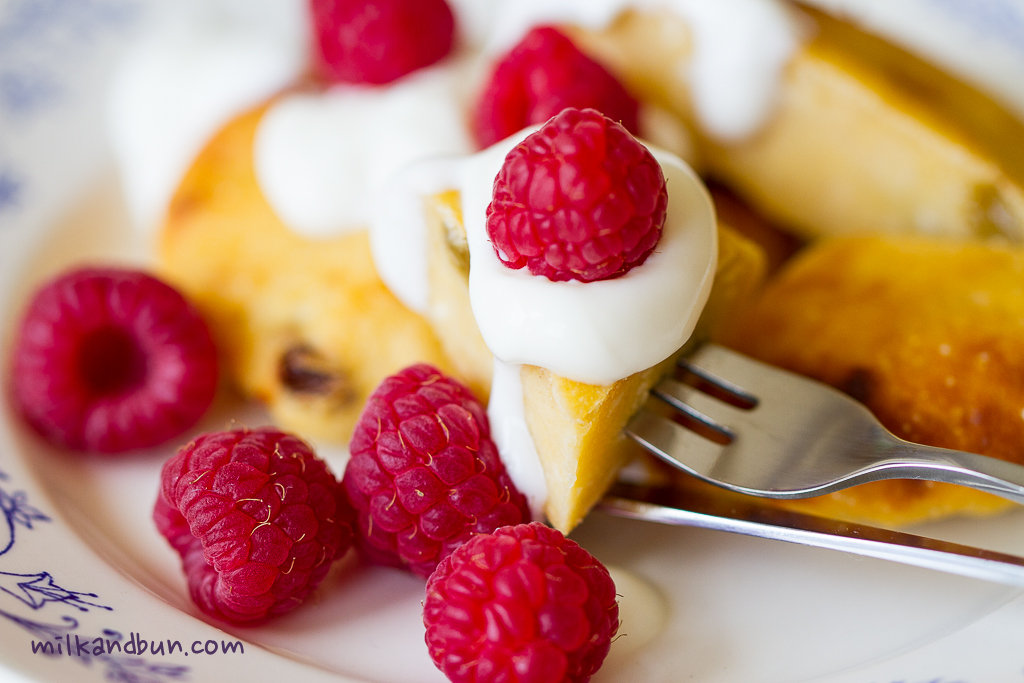
Syrniki

 Syrniki are fried pancakes, which are made from cottage cheese and traditionally garnished with a sour cream. They are very popular and widely-cooked not only in Russia, also in Ukraine, Belarus and Poland. The word ‘syrniki’ is derived from Russian word ‘syr’ which means cheese.
 The main ingredients are cottage cheese, flour, eggs, sugar, sometimes raisins and vanilla. Commonly syrniki are eaten for freakfast, but could be served as a dessert.
 You can find a great variety of syrniki recipes, in one you should add one egg, in another three, in third just few spoons of flour or semolina flour, and etc. Finally, it doesn’t matter which recipe you’re using, just adjust it to suit your own taste.
TIPS:
Flour and sugar. One adds only few tablespoons of flour, in such option, might be difficult to shape syrniki and turn them over during frying, as they will be soft, but at the same time tender and creamy. Amount of sugar is totally depends on your preferences.
Filling. Raisins and vanilla are most popular ingredients for the syrniki filling, but you can go further – add cinnamon, dried apricots, plums or cherries, lemon or orange zest.
Dressing. Sour cream, jam and sweet condensed milk are the most favourite toppings for syrniki. If you neither like the one nor the other, make berry or chocolate sauce, or just dust it with icing sugar, or pour over some honey, add dulce de leche…
Syrniki-2
You can fry syrniki on a moderate heat in a frying pan for 5 minutes on each site or until golden-brown (using few tablespoons of sunflower oil). I propose you the recipe of an oven-baked syrniki, which is much better and healthier, as you don’t need to use oil.

Russian Syrniki

  • Servings: 3-4
  • Difficulty: easy
  • Print
Ingredients:
Cottage cheese, 500g
Eggs, 2
Sugar, 2-4 Tbsp
Flour, 50-80g
a pinch of salt
Semolina, 2 Tbsp
Vanilla sugar or extract, 1 tsp, optional
Raisins/sultanas, 50g
Preparation:
  1. In a small bowl or mug, put raisins, cover with warm water and let it soak, meanwhile you do all below steps. Optionally, you can add a tablespoon of cognac, brandy or rum along with water for an extra flavor. Then pour the water out and wipe raisins.
  2. In a large bowl, combine eggs, sugar and vanilla together and beat well until pale color (use hand whisk or electric mixer).
  3. Add flour, semolina, salt, raisins, and combine well.
  4. Shape beautiful syrniki -about 5cm/2inch in diameter and 1cm/0.5inch wide.
  5. Arrange syrniki on a greased baking tray and bake in preheated 200C/400F oven for 20-25 minutes or until nice golden color.
  6. Serve warm with a dollop of sour cream.
  7. You can keep all remaining syrniki in a fridge, and reheat them next morning.

Syrniki are so delicious that I could eat them every other morning. Cooking of syrniki is highly recommended as alternative to regular pancakes! 🙂

Enjoy! ❤

Syrniki-1

Syrniki-4

Kulebyaka – Russian pie

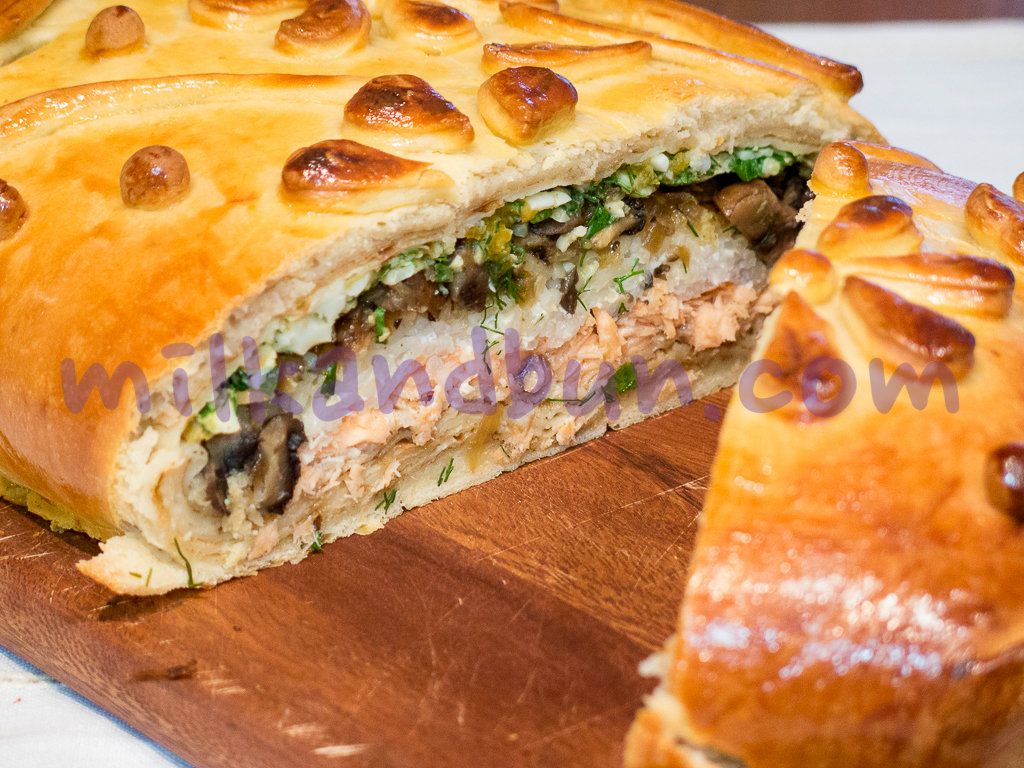
 Kulebyaka or Coulibiac is an authentic Russian hot pie, which has an oblong shape and features several fillings.
The word became from old Russian verb – ‘kulebyachit’, that means to make with hands, to shape, to bend and to knead.
 Pies are always have been loved in Russia. Even famous Russian writers as N.Gogol and A.Turgenev glorified pies in their works. Various pies were always made for every holiday and festival, though it was posh royal celebration or small peasant occasion. Large pies stuffed with several ingredients were really popular, they were baked on Butterweek and Easter and served in taverns and small tea-houses, where each owner had a special recipe and baked very individual pies, different from anyone else’s, i.e. opened and closed pies, feature simple (potatoes or cabbage) or complicated (sturgeon with buckwheat) filling.Festive&Delicious Kulebyaka by milkandbun
  Only in the 17th century, the grand oblong pie, that features several fillings, was named ‘kulebyaka’. The pastry shell was usually made from the yeast dough (the recipe is below). The main distinction of the kulebyaka-pie from any other Russian pie is that the quantity of the filling should be two or three times exceeds the quantity of the pastry; the filling of grand (festive) kulebyaka is usually complicated and separated with thin pancakes.
 The most popular fillings are salmon with buckwheat, ground meat with boiled eggs and rice, cabbage with mushrooms and onions, or visiga – a spinal marrow of the sturgeon, the last one is the unusual ingredient for nowadays, but in the 17-18th centuries it was very common.
 In the 19th century, French chefs, who had worked in Russia, brought the recipe to France and adapted it to the modern cookery, thus the kulebyaka became popular pie not only in Russia. 🙂Beautiful Kulebyaka/Milkandbun
Here is my version of the festival kulebyaka.

Kulebyaka - Russian pie

The yeast dough:
3tsp/5g instant dry yeast
100ml warm milk (or warm water)
2tsp white sugar
2 eggs, at room temperature
1 tsp salt
200ml milk (or water), at room temperature
100g butter, melted
~600g all-purpose/plain/white flour
  1. In a cup, stir warm milk, sugar and yeast together. Let stand until foamy about 10 minutes.
  2. In a big bowl, crack eggs, add sugar, salt, milk, melted butter and stir together. Add sifted flour, yeast mixture and knead the dough until it’s smooth.
  3. Cover the bowl with wet cloth, put in a warm place and leave to rise for 1 hour. After the time, knead the dough again. Repeat this step one more time.
The quantity of dough is enough for kulebyaka and one big pizza.
The filling:
600g fresh salmon, cut into small cubes
100g basmati or jasmine rice, cooked
200g mushrooms, sliced and fried
1 big onion, sliced and fried
4 eggs, cooked and chopped
2+2 Tbsp finely chopped dill and parsley
salt and freshly ground black pepper
The pancakes’ recipe you can find here. You can reduce the pancakes’ batter by half, because you need approximately 9 pancakes.
The glaze:
1 egg yolk beaten with 2Tbsp milk, 1/2tsp salt and 1/2tsp sugar
Assembling:
  1. On a floured surface, roll out the dough to approximately 26cm*35cm rectangular and 6mm thick. You can roll the dough on a piece of baking parchement, thus it’ll be much easier to transfer the pie on a baking tray; moreover, you need to turn the pie upside down-the sealing should be on the bottom.
  2. Coat the rolled dough with the pancakes.
  3. Place the egg and herbs mixture lengthways down the centre of the dough.
  4. Then arrange the mushrooms and onion mixture on top.
  5. Next, arrange rice. And the last layer-salmon.
  6. Cover the filling with pancakes, shape it to make a rectangular.
  7. Then, fold the dough and seal the edges.
  8. Transfer the pie upside down to a baking tray.
  9. Decorate with pastry trimmings, and cut two slits in the top with a sharp knife.
  10. Keep for a proofing for 20 minutes. Brush the pie with egg wash.
  11. Bake in preheated 200C/400F oven for 30-35 minutes or until golden.
  12. Leave to cool slightly for 15 minutes before slicing.
  13. Serve with a glass of milk or a cup of freshly brewed tea.
Enjoy kulebyaka! 😀
 Also I’m really excited to take part in the challenge “yeast and herbs”, that Angie organized with Catherine. I almost thought to give up, because I’m using yeast very-very rare in baking, finally after many days of brain storm it dawned on me that I already baked one awesome pie, so I came up with this recipe. It only seems complicated to make, just try it once and you will see that ‘kulebyaka’ is drool worthy dish! 😀
 Moreover, are you parting at Fiesta Friday? Don’t ask me, because I do and now gonna check some great recipes, which have brought participants. Yay!
 

Vareniki

 Almost everybody in Russia knows and adores vareniki! So do I. 😀
Vareniki – are dumplings, stuffed with savoury or sweet filling.

Vareniki-9

It’s considered that vareniki is a traditional Ukrainian dish, but originally it came from Turkey. It was a dish made from boiled unleavened dough with meat and vegetables filling. When “Vareniki” appeared in Ukraine for the first time, they were called ‘diush-var’. The Ukrainian people liked this dish so much that these dumplings quickly spread over the Ukraine and beyond, and became widely-popular, turned into traditional Ukrainian cuisine and began to call as ‘vareniki, and this name simply means – boiled.
 Ukrainian savoury vareniki are usually topped with shkvarki – fried salted pork fat, and also can be topped with fried onions or just accompanied with sour cream according to local taste or preferences (i.e. last two toppings are quite popular in Russia).
 The most popular fillings are potatoes, mushrooms or fish. Vareniki could be also made sweet, with cherries or sweet cottage cheese filling.
There are many recipes of vareniki nowadays, with egg or sour cream in dough, based on water or kefir.
My recipe is the simplest one, and I used a mix of mashed potatoes and mushrooms. You can use the same dough for sweet fillings, such as cherries or black currant.
Here is the short video how I make these lovely twisted edges of the Vareniki.

Vareniki

  • Servings: ~70 pieces
  • Print
Vareniki can be frozen well, that’s why I usually make a big batch, put them in ziplocks and freeze! No need to defrost before cooking.
 
Ingredients
The dough:
500g plain flour
1 egg
2 tsp salt
200 ml warm water
The filling:
800-900 g potatoes, boiled and mashed
1 onion, cut into small cubes
300 g wild or button mushrooms, sliced
1 Tbsp oil + 1 Tbsp butter 
Small bunch of dill, finely chopped
Salt, pepper to taste
Garnish per portion:
1-2 Tbsp sour cream 
1 Tbsp chopped dill 
a knob of butter 
 
Method
  • Dissolve salt in warm water. On a flat surface make a well in the flour, add egg and salted water. Knead until the dough is pliable. Cover with plastic wrap or towel and let rest for 20 minutes.
  • Meanwhile, saute onion and mushrooms in oil and butter. In a bowl combine mashed potatoes with vegetables and dill. Season to taste. The filling is ready.
  • Roll the dough into 8cm/3-inch circles, place 1 tsp potato mixture into center, fold the dough over filling and press it.
  • Bring a large pot of salted water to boil (salt the water as for pasta or you like). Put vareniki into water and carefully stir with a spoon. When they come to the surface – cook for 4-5 minutes more.
  • Serve vareniki with sour cream, chopped dill and a knob of butter on top.
 You can brown vareniki a bit in a butter straight after the boiling. Serve with sour cream, but already without extra butter on top.
 
Enjoy the delicious vareniki! 🙂

Are you going to Angie’s party? You can try superb cocktail there! 😉

Sunny peachy-nutty cake

Days go by and summer is slowly coming to Dubai, winter doesn’t want to give up though, giving us some cloudy days sometimes but its days are counted…
 One lovely morning I was at home, and looking at the dull skies, I decided to make something special for the afternoon tea, something sunny, sweet-smelling and new, a cake that I’ve not tried before, and it should be fruity. 
I have to say that I do not normally know what I’m going to cook this or next day, I’ve never have a master plan for a week ahead, and prefer to be inspired by details around me, whatever I see, read about food or trying something myself, rather than be organized in the proper food-blogger way 🙂 
  So, I went to a grocery to look for an inspiration. One important and remarkable thing about buying food in Dubai is that large groceries and markets here do always and really inspire me; we have no such variety of fruits in Russia, and every time I go for a shopping, whether it is some oranges for a morning juice or avocados, I never know from which part of the world these fruits or veggies would come from. And that day was not an exception. Without even roaming between fruit rows I remarked some nice peaches shortly after I entered the shop, and once I came closer and took a couple of them in my hand, I already decided that it’s going to be a beautiful peach cake!
 Peaches always remind me of summer, they share the same bright and yellowish colour of the pulp with the sun, giving the cozy feeling of warm and sunny days.
 At home I cut one fruit and tried it. I was slightly disappointed that the peaches weren’t as juicy as I expected, but that  turned into fantastic peach cake in the end… 😉Peach pie-2Ingredients for the cake:
Peaches* – 4 big 
Eggs, at room temperature – 3
Yoghurt -150g or 0.6cup
Sugar* -100g or 0.5cup 
Butter, cut into small cubes – 130g or 0.6cup
Self-raising flour – 150g or 1cup (or 1 cup plain flour + 1 tsp baking powder)
Cornmeal – 2 Tbsp
Whole walnuts – 130g or ~1cup
A pinch of salt
Lemon zest – 2tsp
Orange zest – 1tsp
Ingredients for the mandarin sauce:
3 big mandarins*
2 Tbsp lemon juice
3 Tbsp water
2-3 Tbsp icing sugar
1 Tbsp cognac (or brandy, or Grand Marnier) – optionally
 *Really good substitution for peaches are nectarines! 
*I used only 100g of sugar and that means the cake won’t be sweet, 
I suggest sweeten it with 150g or 3/4cup of sugar.
*I used mandarins, just because :D; oranges go well here too, as you already guess.
 
The cake preparation:
  • In a bowl beat the butter and sugar together;
  • Stir in one by one eggs;
  • Add yoghurt and citrus zest, combine;
  • Ground the walnuts, add to the batter and mix;
  • Sift the flours and salt into the batter mixture;
  • Grease the baking dish with butter or oil. Pour the cake batter into it;
  • Cut the peaches into wedges and stick into batter;
  • Bake in preheated oven 210C/400F for 45-60 minute;.** 
  • Meanwhile prepare the mandarin sauce for the cake;
  • Let the cake cool a bit. Pour the mandarin sauce over it. 
Mandarin sauce preparation:
  • First of all, squeeze the juice out of mandarins; 
  • Combine citrus juices, water and sugar in a small saucepan; bring to boil;
  • Reduce heat to low, add cognac and simmer for 10-12 minutes;
  • Remove from the heat and cool.
**When I’m using a glass dish for the cake, it takes me little bit longer to bake it. 
Thus after 40 minutes, pls check the cake is done or not yet.
To check the cake’s readiness – tuck into a toothpick, if it comes out dry –  the cake is ready.
Peach pie-1
  The final result overcame all my expectations –  the cake tasted fantastically! The peaches became tender and even more sweeter, and because they were not so juicy they kept their integrity. Needless to say about aromatic mandarin sauce.. I’ll definitely be making it again!
 I also suggest to sprinkle some icing sugar on the top along with the citrus sauce.
P.S. Several days back I didn’t even know that there is such type of flour as ‘cake’, thanks to dear fellow-blogger Suzanne, now I know about it and adding cornmeal everywhere…Haha 
Hey, are you still here? 🙂 Go and bake the cake!
 Have a sunny and bright day, guys!

Khvorost

Khvorost-5  Khvorost is a traditional Russian crispy sweet which made out of dough, shaped into twisted ribbons and deep-fried. The name means ‘brushwood’, it was given because of similar look to a real brushwood and  a sound ‘crack-crack’ when you bite the crunchy sweet khvorost. 🙂
 Khvorost was very popular in the 18-19th centuries and commonly eaten among petty bourgeois, shopkeepers, clerks and students, who could gather and spend a little amount of money on this crunchy treat.
  When pastry and confectionery industry progressed after 1930-50th, bringing more sweet products such as caramel candies and variety of cookies the khvorost itself became less popular.
Ingredients
3 egg yolks
1 Tbsp sour cream
100 ml full-fat milk
2 Tbsp cognac (or vodka)
pinch of salt
500g flour (white, all-purpose)
icing sugar for dusting
sunflower oil for deep-drying
Method
 Whisk well egg yolks with sour cream, milk, cognac and salt. Adding the flour gradually to the egg mixture, knead a dough until soft, cohesive and no longer sticky (thus don’t add all the flour at once, or even add some if needed).
 Place the dough in a bowl, cover with a towel or plastic wrap, let it rest for 20-30 minutes.
Roll the dough out on a floured surface to 1cm/0.4″ thick. Cut strips (2-3cm/1″ width and 8-10cm/3-4″ length), make a small cut in each strip and fold one edge into it.
 Heat the oil in a large pan and cook khvorost on both sides until golden (1-2 minutes). Ready ones set on a paper towel to get rid of fat excess.
 Sprinkle with a good quantity of icing sugar.
Sugar is not added into genuine classic khvorost dough , that helps to make it more fluffy; thus sprinkle lots of icing sugar or pour some honey over ready ‘ribbons’ .
Khvorost-3 Enjoy with a cup of black tea or milk, or leave some for the morning coffee! 😉Khvorost-4Follow my blog with Bloglovin
1 10 11 12 14