Tag Archives: Russian food

Pokhlyobka – The Old Russian Pottage

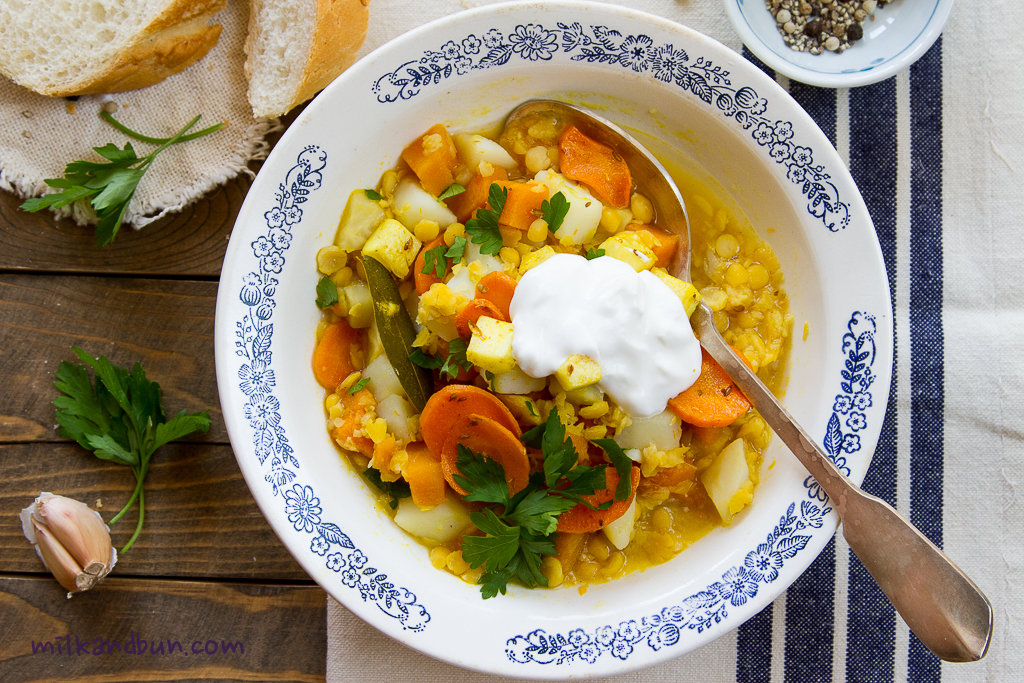
 Pokhlyobka is a kind of thick Russian soup made by adding flour, grains, potatoes or other vegetables. It is similar to the Britain Pottage.
 Long time ago, it was a main meal among poor strata of Russian society. Most of the time, villagers and peasant farmers cooked and ate vegetarian pottage, because such expensive ingredients like meat or fish were not affordable for them. It’s worth mentioning that meat was eaten once or twice a year; more luckily were farmers, who had lived near rivers and could caught a fish throughout the year. The dish was easy to prepare, and people could use the remains of the yesterday meal – chunks of boiled potatoes or cabbage, then add extra millet or buckwheat. The rich part also ate pokhlyobka, but it was significantly better and besides potatoes, contained the meat of duck, hazel-hens, and etc.
Pokhlyobka
 My recipe of Russian pottage is also without meat.. Definitely, a good piece of fatty pork or beef could makes the pokhlyobka especially rich, so if you’re not a vegetarian you may add it. But I suggest you to try the non-meat option, which is infused with aromatic spices, and delicious pumpkin and thick sour cream make the soup absolutely irresistible!
‘Acoulina cooked absolutely delicious koulebyaks, various pokhlyobki..kvas..soaked apples..’ from the Russian novel ‘Whites, blacks and grays’  by Ivan Lazhechnikov written in 1856.
Pokhlyobka - the old Russian thick soup
  ‘The dinner was absolutely delicious that day: pokhlyobka made from goose meat with wild onions, venison shashlik and slices of bear meat..’ from the Russian novel ‘Plutonia’ by Vladimir Obruchev written in 1915.

Pokhlyobka - The Old Russian Pottage

  • Servings: 2-3
  • Difficulty: easy
  • Print
Ingredients
120-130g yellow split peas
3 small potatoes
300g pumpkin or squash
1 medium carrot, sliced
60-70g celery root, cut into small cubes
1 small onion, thinly sliced or finely chopped
1 garlic clove, chopped, optional
1/2 tsp ground turmeric
1 tsp cumin
2 bay leaves
1.2 l water
1 Tbsp sunflower oil
salt, black pepper to taste
fresh parsley, chopped, for serving
sour cream, for serving, optional
fresh country-style bread, for serving, optional

Preparation

  1. Wash peas, put in a pan, cover with water and soak overnight. Pour out the water. Cover peas with new cold water. Boil on a medium heat for 15-20 minutes, until peas are tender. Skim the foam during the boiling.
  2. Meanwhile, in a frying pan, heat the oil, add spices and fry them for a minute. Add garlic, onion, carrot, celery root and saute vegetables on a medium heat for 8-10 minutes.
  3. Peel and cut into small cubes potatoes and pumpkin.
  4. Add potatoes to the pottage. Season with salt and pepper. Simmer for 8-10 minutes.
  5. Add pumpkin along with fried vegetables, simmer the pottage for 10 minutes more or until the pumpkin is soft.
  6. Adjust seasoning. If the pottage is too thick, add more hot water and stir through.
  7. Garnish each plate with a dollop of sour cream and chopped parsley. Serve with a slice of bread.
Enjoy the old Russian farmer meal! 🙂
I’m bringing this traditional recipe to all lovely people who’s enjoying the FF party today!
Russian beetroot salad

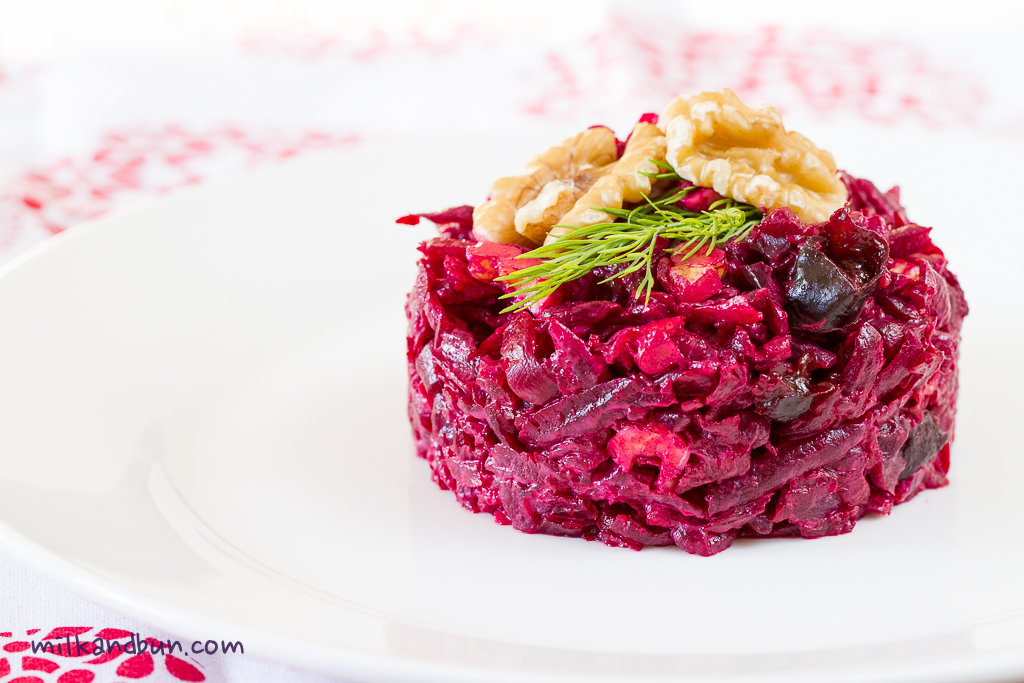
This simple salad is well-known in Russia. It brings back memories about my childhood, parents’ home and cold evenings, when we made the salad and then ate it. Beets, walnuts and garlic is a very good source of vitamins and oils, which is important during winter days. Prunes is another wonderful ingredient here, it adds sweetness to the salad (especially if the beets aren’t sugary); moreover, prunes have health benefits – they have a high anti-oxidant content and contain dietary fiber*.

 I still love and make this salad. For me it’s certainly a good and comforting recipe. You can serve it also as a side dish to grilled meat, burgers or chicken. I hope you do give it a try! So easy and so tasty! 🙂
Russian beetroot salad

Russian beetroot salad

  • Servings: 2-3
  • Difficulty: easy
  • Print
Russian beet saladIngredients
2 medium beets
6-8 prunes (dried plums), pitted
2 cloves of garlic, minced
a handful of walnuts
2-3 Tbsp sour cream
salt, black pepper to taste
fresh dill, optional, for garnish
rye bread, for serving
Preparation
  • Boil or roast beets until they’re tender. Cool, peel and grate beets (using medium-hole grater).
  • If prunes are too dry, soak them in a warm water for 10-15 minutes. Then roughly chop prunes and walnuts.
  • Mix all ingredients in a bowl. Garnish with dill, if desire. Serve with rye bread.
Enjoy!

Classic Beef Stroganov

 Beef Stroganov is a well-known Russian dish, which become extremely popular in many countries. It consists of fried beef cubes mixed with sour cream sauce. Various explanations are given for the name, one says that such dish was firstly appeared at the count Alexander Stroganov’s dinners, who was the Russian minister of the interior from 1839, the member of the state Council from 1849 and the governor general of Novorossiia from 1855. The sauteed beef was among other different dishes, which were served at ‘open tables’ when all decorous and presentable people could came in straight from the street and tried any meal.
 The first known Beef Stroganov recipe doesn’t contain onions or mushrooms, only floured beef cubes, which fried and sauced with mustard, bouillon (stock) and some sour cream. Thus, you may guess that it’s not the best recipe. The dish becomes much tastier and aromatic if you add onions and mushrooms (it tastes fantastic with cep mushrooms, even if you add only one), such recipe is considered now as classic Beef Stroganov.
Beef Stroganov

Classic Beef Stroganov

  • Servings: 4
  • Difficulty: moderate
  • Print
 
You can also serve the beef with buckwheat instead of mashed potatoes.
IngredientsRussian Beef Stroganov
500g beef fillet, cut into medium cubes
2 medium brown onions, thinly sliced
200-300g mushrooms, sliced (cep mushrooms or brown champignons)
2-3 Tbsp plain flour
150-200ml sour cream
2 tsp dijon mustard
2-3 Tbsp beef stock
butter or sunflower oil
sea salt, black pepper to taste
mashed potatoes, chopped dill or parsley, rye bread, for serving
 
Method
  1. To make the sour cream sauce, in a small bowl, combine the sour cream with mustard, add stock to make it more thin (it should be liquid like kefir).
  2. Mix the flour with a good pinch of salt. Lightly flour beef cubes from all sides, shake off any flour excess. Heat the heavy frying pan, when it’s hot, add butter or sunflower oil. Then sear beef cubes in 2 or 3 batches, so you don’t overcrowd the pan and steam the meat. Cook for 2-3 muntes or just until browned. Transfer to the plate.
  3. In the same frying pan (reduce the heat to medium), add a knob of butter, mushrooms and onions. Fry onion until it’s soft. Then add fried meat, season with salt and pepper. Reduce the heat to medium-low, you need to warm the meat mixture for 2-3 minutes. Now add the sauce, stirring continuously for 1-2 minutes. Remove the pan from the heat, cover with lid and let it rest for few minutes.
  4. Serve with mashed potatoes, sprinkle with dill or parsley. Enjoy!
You can keep the dish in the fridge up to 1-2 days. Keep the fried meat and sour cream sauce separate in the different containers. Just mix it together and rewarm before serving (but don’t let the sauce bubble).

Kulebyaka – Russian pie

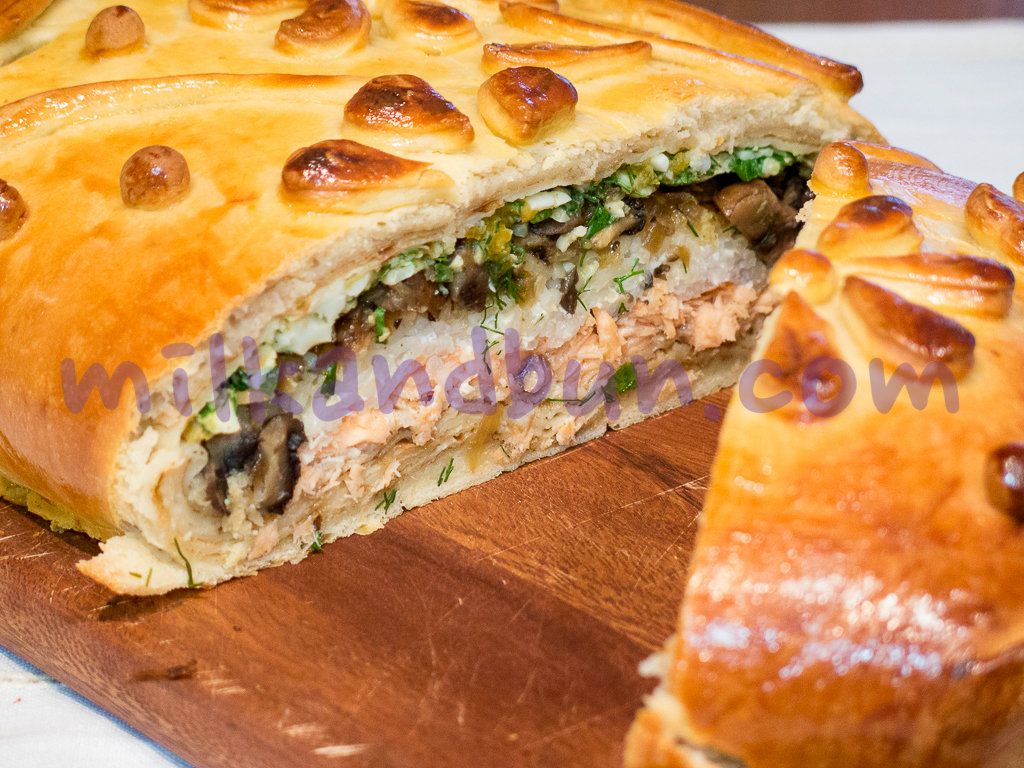
 Kulebyaka or Coulibiac is an authentic Russian hot pie, which has an oblong shape and features several fillings.
The word became from old Russian verb – ‘kulebyachit’, that means to make with hands, to shape, to bend and to knead.
 Pies are always have been loved in Russia. Even famous Russian writers as N.Gogol and A.Turgenev glorified pies in their works. Various pies were always made for every holiday and festival, though it was posh royal celebration or small peasant occasion. Large pies stuffed with several ingredients were really popular, they were baked on Butterweek and Easter and served in taverns and small tea-houses, where each owner had a special recipe and baked very individual pies, different from anyone else’s, i.e. opened and closed pies, feature simple (potatoes or cabbage) or complicated (sturgeon with buckwheat) filling.Festive&Delicious Kulebyaka by milkandbun
  Only in the 17th century, the grand oblong pie, that features several fillings, was named ‘kulebyaka’. The pastry shell was usually made from the yeast dough (the recipe is below). The main distinction of the kulebyaka-pie from any other Russian pie is that the quantity of the filling should be two or three times exceeds the quantity of the pastry; the filling of grand (festive) kulebyaka is usually complicated and separated with thin pancakes.
 The most popular fillings are salmon with buckwheat, ground meat with boiled eggs and rice, cabbage with mushrooms and onions, or visiga – a spinal marrow of the sturgeon, the last one is the unusual ingredient for nowadays, but in the 17-18th centuries it was very common.
 In the 19th century, French chefs, who had worked in Russia, brought the recipe to France and adapted it to the modern cookery, thus the kulebyaka became popular pie not only in Russia. 🙂Beautiful Kulebyaka/Milkandbun
Here is my version of the festival kulebyaka.

Kulebyaka - Russian pie

The yeast dough:
3tsp/5g instant dry yeast
100ml warm milk (or warm water)
2tsp white sugar
2 eggs, at room temperature
1 tsp salt
200ml milk (or water), at room temperature
100g butter, melted
~600g all-purpose/plain/white flour
  1. In a cup, stir warm milk, sugar and yeast together. Let stand until foamy about 10 minutes.
  2. In a big bowl, crack eggs, add sugar, salt, milk, melted butter and stir together. Add sifted flour, yeast mixture and knead the dough until it’s smooth.
  3. Cover the bowl with wet cloth, put in a warm place and leave to rise for 1 hour. After the time, knead the dough again. Repeat this step one more time.
The quantity of dough is enough for kulebyaka and one big pizza.
The filling:
600g fresh salmon, cut into small cubes
100g basmati or jasmine rice, cooked
200g mushrooms, sliced and fried
1 big onion, sliced and fried
4 eggs, cooked and chopped
2+2 Tbsp finely chopped dill and parsley
salt and freshly ground black pepper
The pancakes’ recipe you can find here. You can reduce the pancakes’ batter by half, because you need approximately 9 pancakes.
The glaze:
1 egg yolk beaten with 2Tbsp milk, 1/2tsp salt and 1/2tsp sugar
Assembling:
  1. On a floured surface, roll out the dough to approximately 26cm*35cm rectangular and 6mm thick. You can roll the dough on a piece of baking parchement, thus it’ll be much easier to transfer the pie on a baking tray; moreover, you need to turn the pie upside down-the sealing should be on the bottom.
  2. Coat the rolled dough with the pancakes.
  3. Place the egg and herbs mixture lengthways down the centre of the dough.
  4. Then arrange the mushrooms and onion mixture on top.
  5. Next, arrange rice. And the last layer-salmon.
  6. Cover the filling with pancakes, shape it to make a rectangular.
  7. Then, fold the dough and seal the edges.
  8. Transfer the pie upside down to a baking tray.
  9. Decorate with pastry trimmings, and cut two slits in the top with a sharp knife.
  10. Keep for a proofing for 20 minutes. Brush the pie with egg wash.
  11. Bake in preheated 200C/400F oven for 30-35 minutes or until golden.
  12. Leave to cool slightly for 15 minutes before slicing.
  13. Serve with a glass of milk or a cup of freshly brewed tea.
Enjoy kulebyaka! 😀
 Also I’m really excited to take part in the challenge “yeast and herbs”, that Angie organized with Catherine. I almost thought to give up, because I’m using yeast very-very rare in baking, finally after many days of brain storm it dawned on me that I already baked one awesome pie, so I came up with this recipe. It only seems complicated to make, just try it once and you will see that ‘kulebyaka’ is drool worthy dish! 😀
 Moreover, are you parting at Fiesta Friday? Don’t ask me, because I do and now gonna check some great recipes, which have brought participants. Yay!
 

Kournik – Russian chicken pie

Hello, dear foodies!

In Russia we really do like pies, to bake and to eat! 🙂 And I’m not an exception. 🙂

Kournik – the festive pie which used to bake for weddings. It was shaped like a dome, interlaid with thin pancakes and stuffed with various fillings: boiled chicken, fried mushrooms, rice, eggs and etc. Nowdays, preparing of the pie is left for weekends. But there is the simplified version of it, which Russian women cook during working-days. 

 Hope this simple and tasty pie can turn into a family favorite!

So, we need

For pastry:

260-300 gr plain flour

150 gr sour cream

150 gr butter

1 egg

pinch of salt

Kournik-1For filling:

2 chicken breasts

2-3 potatoes

1 onion (big one)

a few small cubes of butter

1 egg for brushing

salt and pepper

Mix the flour, pinch of salt, soft butter, sour cream and egg together in a bowl. Then you need to work on a surface – mix together to form a soft pastry.

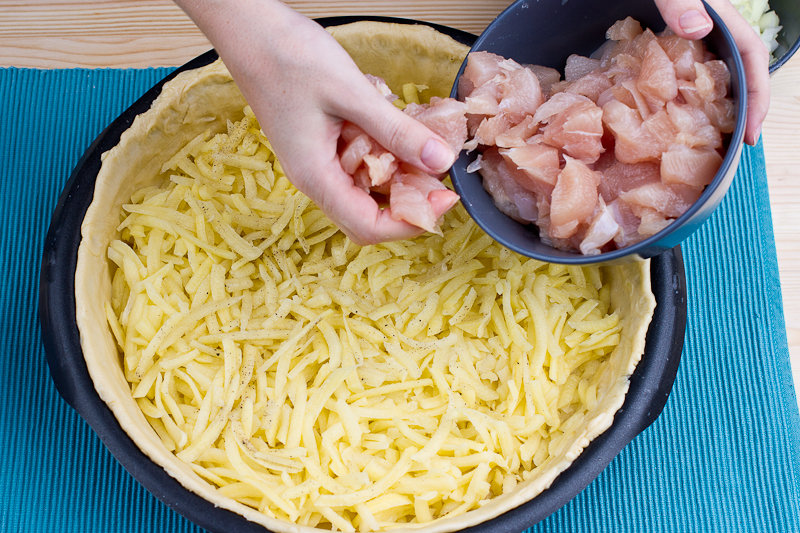
Shape the pastry into a ball and cover with a towel. Meanwhile, cut the chicken and onion into cubes and grate potatoes.

Kournik-2

Divide the dough into 2 parts, one should be smaller- will be the lid (upper part) for our pie.  On a lightly floured surface, roll out the pastry until it’s roughly the size of the pie dish.

Spread the potatoes in an even layer, season with salt and pepper

Kournik-3

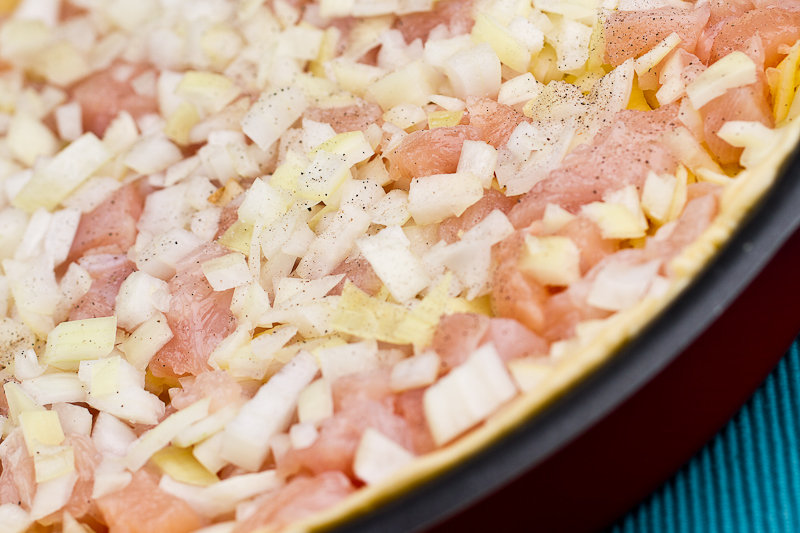
then the chicken with onions, season with salt and pepper

Kournik-4Kournik-5

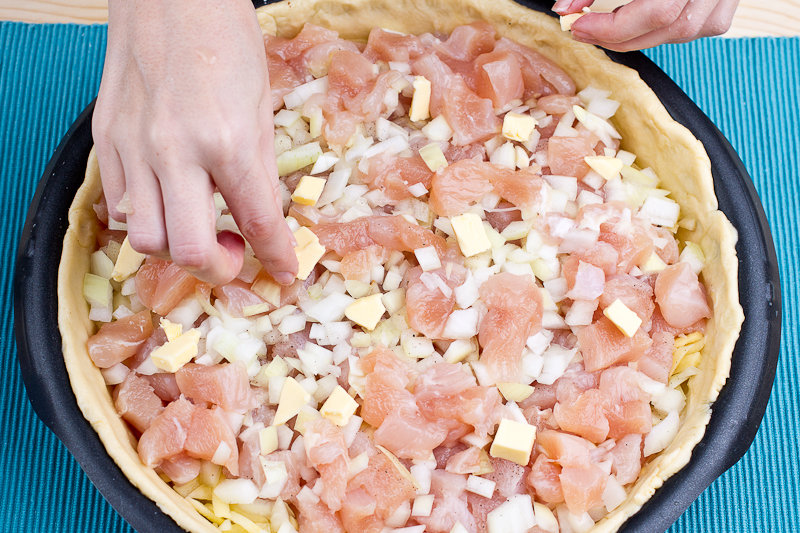
Then put small cubes of butter over filling (for juiciness).

Kournik-6

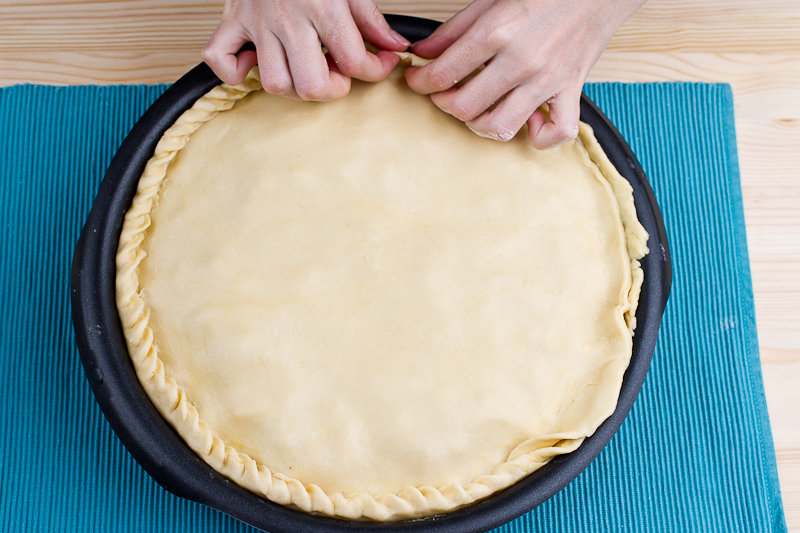
Roll the remaining pastry out – to cover the pie.  Pinch the edges to seal.

Kournik-7Kournik-8

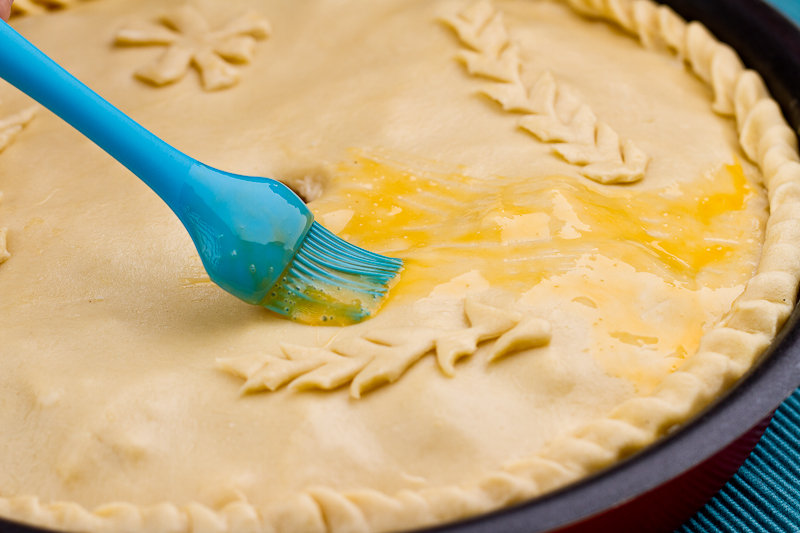
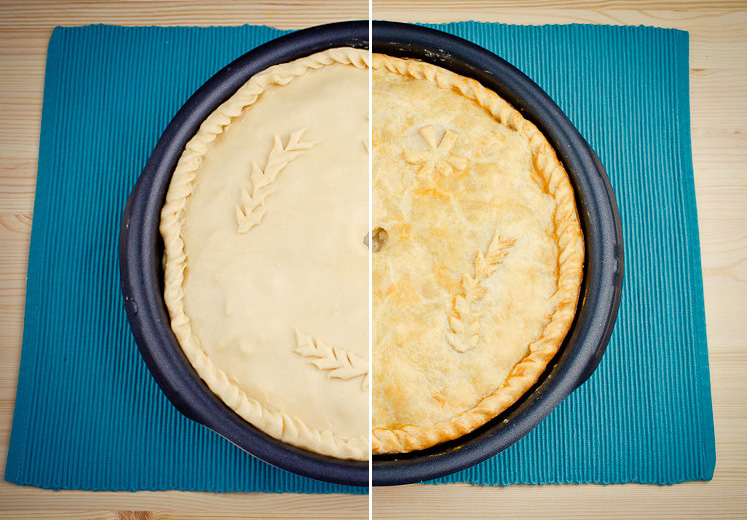
Make a small hole in the center of the pie (use your forefinger) and be imaginative-decorate 🙂

Kournik-11Brush all over with beaten egg and bake in the oven for 1 hour (190-200°C or 380-400°F), until golden.

Kournik-12Serve with hot tea or cold milk. Enjoy! 🙂Kournik-13
*I used 28cm baking dish;

**Were used 3 chicken breasts and 2 potatoes;

***And don’t throw pastry’s leftovers! Make a small pie, using leftovers of the pastry and potatoes!