Tag Archives: Russian tradition

Khvorost

Khvorost-5  Khvorost is a traditional Russian crispy sweet which made out of dough, shaped into twisted ribbons and deep-fried. The name means ‘brushwood’, it was given because of similar look to a real brushwood and  a sound ‘crack-crack’ when you bite the crunchy sweet khvorost. 🙂
 Khvorost was very popular in the 18-19th centuries and commonly eaten among petty bourgeois, shopkeepers, clerks and students, who could gather and spend a little amount of money on this crunchy treat.
  When pastry and confectionery industry progressed after 1930-50th, bringing more sweet products such as caramel candies and variety of cookies the khvorost itself became less popular.
Ingredients
3 egg yolks
1 Tbsp sour cream
100 ml full-fat milk
2 Tbsp cognac (or vodka)
pinch of salt
500g flour (white, all-purpose)
icing sugar for dusting
sunflower oil for deep-drying
Method
 Whisk well egg yolks with sour cream, milk, cognac and salt. Adding the flour gradually to the egg mixture, knead a dough until soft, cohesive and no longer sticky (thus don’t add all the flour at once, or even add some if needed).
 Place the dough in a bowl, cover with a towel or plastic wrap, let it rest for 20-30 minutes.
Roll the dough out on a floured surface to 1cm/0.4″ thick. Cut strips (2-3cm/1″ width and 8-10cm/3-4″ length), make a small cut in each strip and fold one edge into it.
 Heat the oil in a large pan and cook khvorost on both sides until golden (1-2 minutes). Ready ones set on a paper towel to get rid of fat excess.
 Sprinkle with a good quantity of icing sugar.
Sugar is not added into genuine classic khvorost dough , that helps to make it more fluffy; thus sprinkle lots of icing sugar or pour some honey over ready ‘ribbons’ .
Khvorost-3 Enjoy with a cup of black tea or milk, or leave some for the morning coffee! 😉Khvorost-4Follow my blog with Bloglovin

Happy Women’s Day!

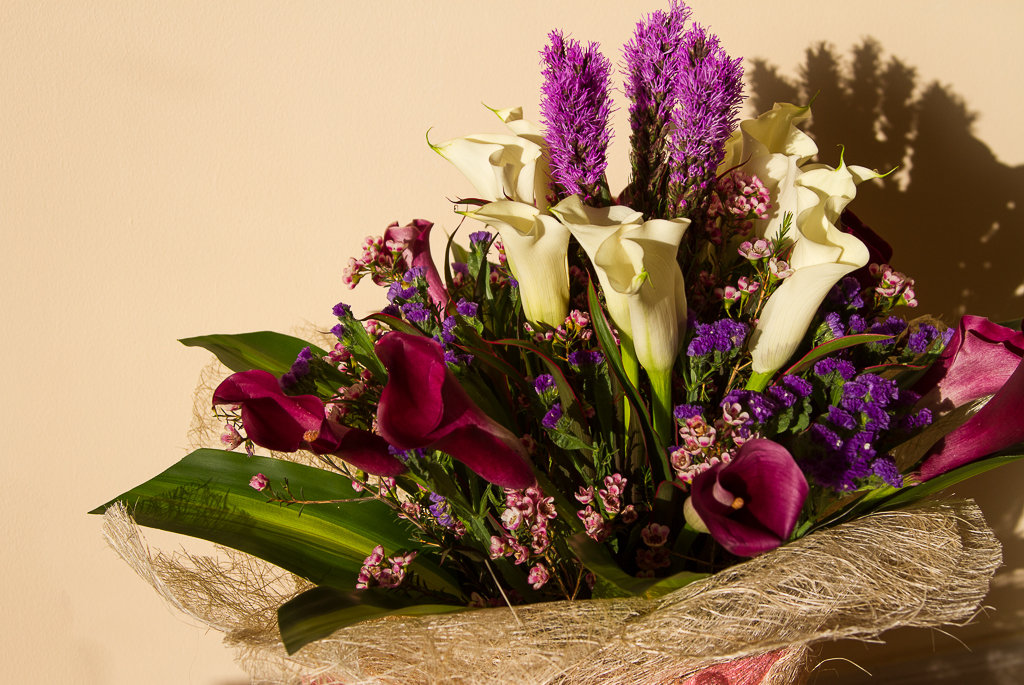
 Today is ‘The International Women’s Day’ in Russia. It’s not widely celebrated in the world as far as I know but it’s similar to the Mother’s Day in Europe and North America. Traditionally men buy various gifts and flowers for close relatives like wives, mothers, sisters, daughters and also female colleagues. Flowers, such as tulips and mimosas, are associated with the upcoming spring and one of the popular gifts across the Russia along with perfume and chocolates.
 
 Meanwhile, it’s Fiesta Friday by Angie, which I enjoyed a lot last time and met so many lovely bloggers. And I’m bringing these beautiful flowers to you and FF. 
 
 I wish all ladies very bright day, many flowers around, happiness and joy! 😀
flowers

Russian schi (cabbage soup)

 
 Today is 3rd day of Butterweek (Rus.-Maslenica) in Russia. It’s spring festival, saying goodbye to the winter, and the week before Lent. During the week we bake pancakes (we say exactly bake, not cook, even though we fry them on a pan) almost every day, invite relatives and friends, and our hearts fill with a joy of the upcoming spring.
 Every day of Butterweek has the name and meaning. Today (Wednesday) is ‘Lakomka’ – Gourmand. When wife’s mother invites son-in-law and treats him with pancakes. Unmarried boys and girls usually went to slide from snow hills. Old folks bantered with guys, who hadn’t married that year and played various pranks to them. And guys bribed with pancakes and candies.
 More you can read in my previous post here. 
 
 I’d like to tell you about another no less famous Russian dish – Schi, it’s cabbage soup, similar to Borsch (with cabbage and beetroots). Everyone knows and enjoy it. 😉
Schi-9
 Schi is the main hot Russian dish over a millennium. Peasants started to cook it a long time ago in the 9th century when cabbage has begun to cultivate everywhere in Russia. In spite of the fact that people’s tastes have been changing, the soup is always been eaten.
 Of course, schi was not the same for all social classes. Full of content, with meat and thick cream, was called ‘rich’, other ‘empty’, as it was cooked only from cabbage and onion.
 To create a special and unique schi’s taste, it was prepared in clay or cast-iron pot in Russian petch/oven. ‘Schi’s spirit’ was always in homes, that means everybody cooked it. The Russian proverb says ‘Schi and kasha is our food’, as they were eaten every day.
 
 Schi consists of six major components: cabbage, meat (or mushrooms rarely), roots (carrot, parsley), spice part (onions, garlic, bay leaves, black pepper) and sour part (sour cream, apples or cabbage brine). First and last parts are essential and absolutely compulsory. Thus, the simplest schi could be done from cabbage and sour cream 🙂
 The notable feature of schi (that you cook not just a simple cabbage soup) is a slightly sour taste, which usually archived by adding sour cream, sour/salted cabbage, and brine or salted mushrooms into the soup.
  
 Originally, flour was added as well to make schi thicker, but such ‘dressing’ spoiled the taste and then began to add potatoes or buckwheat.
 
 Considered that the ideal schi is so thick, that if you put a spoon into the soup, it holds vertical position and doesn’t fall. 😀 or when a huge piece of meat is risen above a plate of schi.
 
 Health-giving properties of the soup allowed to consume it frequently. There are many schi versions: ‘summer schi’ with fresh cabbage or sorrel, ‘winter schi’ with sour cabbage, ‘lenten/lean schi’ without meat and etc. Mine is with fresh cabbage and meat.
 For the meat part better to choose fatty beef, belly or rump, bone in. Even you can add some pork. I used boneless lamp, because couldn’t find a proper piece of beef.
 When the soup is ready, leave it for 15-30 minutes to get the enhanced flavor. A similar principle is brewing tea, we keep it for 3 minutes to get a wonderful aroma. So, you can make a big pot of schi and eat it all week long. 🙂

Russian schi

  • Servings: 5-6
  • Difficulty: easy
  • Print
 

Ingredients
500-600g lamb or beef
300-400g cabbage
3 medium potatoes
1+1 onion, for broth and frying
1+1 carrot, for broth and frying
2-3 tsp tomato paste
small bunch of parsley and/or dill
2 bay leaves
5 whole peppercorns
2 tbsp. sunflower oil, for frying
1 garlic clove
sour cream, good quality 
rye or wholemeal bread
salt, black pepper to taste
 
Preparation
    • Put the meat inn a large soup pot, cover with 3 litres of water, bring to boil and remove the foam.
    • Meanwhile, grate carrot and dice onion. Sauté vegetables until they are soft for 10 minutes. Stir in tomato paste and sauté for 3-4 minutes more.
    • Take and throw carrot and onion out, we won’t use them anymore.
    • Take the meat out as well. Cut into small cubes and keep aside.
    • To get the clear soup, you can strain the broth through cheesecloth (optionally).
    • Season the broth with salt and black pepper to taste.
    • Slice potatoes, add into the broth and boil 15 minutes.
    • Thinly shred the cabbage and add to the potatoes (when they are half way done) along with meat cubes.
    • Again bring to boil and simmer for 15-20 minutes until vegetables are soft.
    • Add sautéed carrot and onion to the pot along with bay leaves, whole peppercorns (you can smash them little bit), salt and pepper. Simmer for 10 minutes.
    • Add chopped parsley/dill and crushed garlic.
    • Turn the heat off, cover the pot with a lid and let it stand at least for 15 minutes.
  • Serve with a dollop of sour cream and rye or wholemeal bread.
 
Enjoy Russian lunch! 🙂

You can click on any picture to have a look it in full size.

Russian pryaniki – gignebread

  Today is Christmas in Russia. I wish wonderful and magical day to all Orthodox Christians!
Pryaniki_snowflakes

 Pryaniki were ones of the favorite treats in Rus’ (old name of Russia). The name was given for it’s spicy aroma and taste. They are similar to gingerbread cookies, but often made more thick.

 Pryanik was the symbol of holiday, because ingredients weren’t cheap and used daily. It’s been baked for the Christmas, Easter, weddings and birthdays. There were quite a lot ceremonies and traditions about pryaniki.
 
 In 9th century, first pryaniki were called “honey bread”, they were baked from rye flour with honey and berry juice, honey contained the half of all mixture. Later wild flowers and spices were added in a pastry.
 In 7-8th centuries, when exotic spices were brought from India and Middle East to Russia, pryanik was named “pryanik”. Spices for pryaniki were called “dry perfume”, among which black pepper, orange and lemon zest, mint, vanilla, cinnamon, ginger, anise and clove were most used and favorite.
 In 17-19th centuries, baking of pryaniki was widely-spread craft. In every area people baked their special pryaniki according to traditional recipes; preparation’s secrets were passed on from one generation to another.
 
Ingridients:
For  the pastry:
100-120 ml honey
300g flour
1 tbsp butter
1 egg
1/3 tsp baking soda
1/4 tsp spice mix*
50ml water
1 tbsp cognac, brandy or vodka (optionally)
 
For the frosting:
1 egg white
150g icing sugar (powedered sugar)
 
*Spice mix:
1/3 tsp powdered coriander
1/3 tsp cinnamon
1/6 tsp nutmeg
a pinch of cardamom
a pinch of clove
a pinch of allspice
 
Honey and water heat in a pot (turn the heat off before the mixture begin to simmer). Take the pot away from the heat, add half of the flour (sifted) and mix intensively until smooth.
Cool the mixture until room temperature.
Then add the egg, cognac, spices, soda and the remaining sifted flour. Mix the pastry well during 15 minutes; it should be soft and tender.
Roll out the pastry in 5-6 mm/2 inch sheet and cut out any shape you like.
Bake in preheated 200C/400F oven for 15-18 minutes.
 
While the pryaniki are cooling, prepare the frosting. Beat well egg white, add sugar and beat again untill smooth. Put the ready frosting in a bag and decorate the pryaniki.
 
Enjoy with a cup of hot tea or a glass of milk. 🙂
 
 Keep the pryaniki in a box, it can be stored during long time.
Pryaniki_ornament

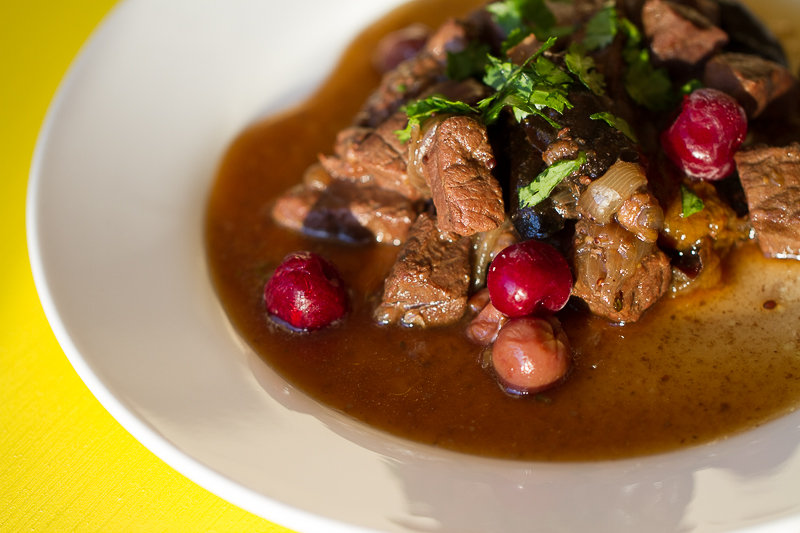
Slow-cooked beef with fruits

  In Russian language, we have one word “tomlenie”, which is similar to the word “stewing”, but has a significant distinction. Tomlenie is a slow-cooking process of meat, fish or vegetables in Russian petch (oven/stove, have a look at the pictures of traditional Russian petch here and here).  
  Nowadays traditional Russian ovens can be found only in out-of-the-way places (villages and provinces, located in the remotest depths of the country).
  It’s considered that, slow-cooking in the common oven is close to the “tomlenie” process, but the real taste and aroma of dishes prepared in Russian petch unfortunately couldn’t be done anywhere else.

Slow-cooked meat

Let’s try to prepare the closest dish.
First of all, we need a clay pot with a lid. 
Be patient! Stewing will take several hours.
Don’t worry! During this time you don’t need to check or mix the dish every 10-20 minutes, thus you can have a break and watch your favorite movie, and even prepare a side dish. 🙂

Beef with fruits

If you don’t have clay pot-use casserole.
If you don’t have a lid -cover the pot with foil.
Replace cherries with cranberries.
Omit the sugar.
Spice the meat with 1/3 tsp of crushed cardamom, it brings a nice interesting note. 
You can add 2-3 tbsp of dry red wine for the better taste (after the frying meat).
Ingredients to feed 4 people:
Beef, cut into 2-3cm cubes – 700g/1lb
Golden onion – 1 big, sliced
Pitted prunes – 150g/5 oz
Cherry fresh or frozen – 150g/5 oz
Sunflower or olive oil for frying- 1 tbsp
Cinnamon – 1/2 tsp
Sugar – 1 tbsp
Bay leaves – 2
Whole black peppercorns – 8-10
Salt, pepper – to taste
some parsley, chopped
 
Method:
  • Heat the oil in a frying pan and fry the onion for 5-7 minutes, add beef cubes and fry until slightly browned.
  • Sprinkle the meat with sugar and cinnamon.
  • Put the meat in a clay pot, add boiling water (just to cover the meat), bay leaves and peppercorns. Season with salt and pepper. 
  • Don’t forget to close the pot with a lid! 🙂
  • Transfer to a preheated oven, 200C/400F, for 2 hours.
  • Check the quantity of the liquid, and add some more water  – if desired (the meat always should be in the broth).
  • Reduce temperature to 180C/380F and return to the oven for a further 1 hour.
  • Add prunes and cherries (no need to defrost), check the seasoning and return again to the oven for 30 minutes.
  • Switch the oven off and leave the pot in it (until the oven is still warm).
  • Sprinkle with fresh parsley.
 
The good garnish to such meat is a buckwheat porridge, mashed or boiled potatoes. It could be served with broth; in a clay pot or on a serving plate.
Enjoy the holiday dinner! 🙂