Russian cuisine

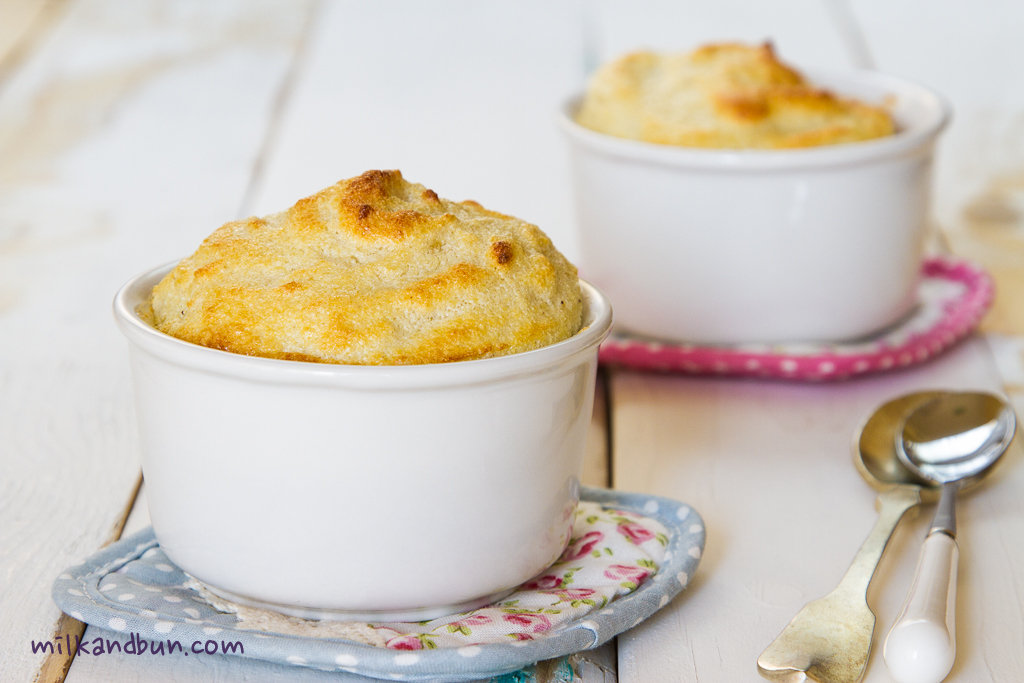
Apple soufflé

 It seems I’d been eating and eating during the past two months, too many delicious pies and sweets, so me and my husband decided to limit the amount of sugar and fat in our regime and keep more healthy diet for a month or so. Diet doesn’t mean the food should be tasteless and dull. Thou, plain meal like steamed fish with broccoli or buckwheat isn’t so bad, especially after a few days of eating it without adding too many salt, spices, butter, cheese or whatever makes it more yummy. 😀
 Another happy moment – desserts for healthy diet do exist! A good and tasty example is Apple Souffle. Apples are baked, then pureed and mixed with egg whites, after those easy steps you need to bake it and voila – tender, airy and delicious dessert is ready! 🙂
I adapted the recipe from old Russian book published in 1984. Apple Souffle

Apple soufflé

  • Servings: 2
  • Difficulty: moderate
  • Print
You can serve apple soufflé with cold whipped cream or a glass of cold milk.
Ingredients
300-350g apples
2-3 tbsp water
2 tbsp white caster sugar
1 tsp cinnamon, optional
2 egg whites
a pinch of salt
some butter or oil for greasing
Instruction
  1. Wash, peel, core and cut apples into 4 slices. Put on a baking tray, add water and bake in preheated 180C oven for 20-30 minutes or until soften.
  2. Puree apples. Put apple puree in a small pan, add sugar and cinnamon, cook on a medium heat for 10 minutes, stirring occasionally.
  3. Meanwhile, beat egg whites with a pinch of salt until soft peaks. Continue beating, add warm apple puree and beat all together for 2-3 minutes more.
  4. Brush ramekins with butter, pour in apple mixture. Bake in preheated 180C oven for 15-20 minutes.
  5. Serve warm. Enjoy!

I’m bringing these delicious and beautiful soufflé to all wonderful bloggers who is celebrating Fiesta Friday anniversary at Angie’s place and two co-hostesses Selma and Nancy. Enjoy! 🙂

Macaroni a la flot

 Flot means fleet in Russian. This simple dish consists of macaroni mixed with fried minced meat. In 17-18th centuries, in Russia similar dishes were quite popular among travelers and especially sailors; that no-fridge time meat was salted-cured and kept in barrels, thus seamen could cut a piece of the meat anytime, fry it and mix with some boiled macaroni. The dish became popular again during World War, but instead of fresh or frozen meat was used tushonka – canned stewed meat (usually fatty pork or beef), which was always on hand, and it could be stored up for years without loosing its nutritional value. Post-war period was also hard time for Russia, so such not expensive and nourishing dish didn’t get out of use. Nowadays, ‘macaroni a la flot’ are still widely-cooked and well-known dish; normally pasta tubes are used for macaroni, which mixed with fried minced meat (it can be pork, beef or mixture), onions and sometimes tomato paste or fresh chopped tomatoes.Macaroni a la flot

Macaroni a la flot

  • Servings: 4
  • Difficulty: easy
  • Print

You may try to add a shredded carrot or chopped tomato and saute it along with meat.

Ingredients
500g minced beef meat (with not less then 15% fat, or you may add some pork)
350g uncooked tube macaroni (like maccheroni, maccheroncini, bucatini, ziti or any other)
1 medium onion, finely chopped
1 Tbsp sunflower oil (or any other veg.oil)
1/2 Tbsp butter
salt, black pepper
chopped parsley or fennel for garnish, optional
Instructions
  1. In a deep pan, melt the butter with oil on a medium heat, add onion and fry for 4-5 minutes. Add meat and use wooden or stiff spatula to break it up into small pieces. Season to taste. Ensure you stir the meat regularly so it doesn’t stick to the pan and to  make sure it cook evenly. The meat is cooked when it shows no signs of pink.
  2. Meanwhile, put pasta into a large pot of boiling water. Be sure to add plenty of salt to the water. Cook the macaroni according to package instruction.
  3. Add 3-4 Tbsp of pasta-boiling water to the meat, mix well.
  4. When the pasta is al dente, drain it and add to the pan with meat. Give it a good stir.
  5. Serve warm. Sprinkle with chopped parsley or fennel, if desired.

Enjoy!

Siberian fish pie

This pie is called Siberian. Try to guess why? First of all, fish has always been a favourite food and often the main dish for people living by the sea or river. One of the famous Siberian dishes is “stroganina”, which is thin chips cut from fresh frozen fish (or it can be meat) and dipped into the mixture of salt and pepper. Also fish is used as a stuffing for large and small pies, for soups and stews. Also, it’s necessary to take into account the Siberian weather, during the winter the temperature is very low (or to be exact – the freezing cold), thus any fish can be easily frozen and kept outside for a long time.Delicious Siberian Fish Pie
 So, I used halibut for my Siberian pie, it’s a flatfish that live in the Sea of Okhotsk and Bering Sea (Russian North seas). Halibut is a valuable source of Omega-3 fat acids and vitamins-B, what makes the pie more healthy and tasty. You can substitute halibut with any other white-meat fish. Along with the fish I added cooked millet, it’s unusual cereal for the filling, but an interesting alternative to the common rice, it has a nice tender texture.
The pie is satisfying and makes a delicious weekend dinner!

Siberian fish pie

  • Servings: 8-10
  • Difficulty: moderate to difficult
  • Print
Rich Leavened Dough
500-600g all-purpose/plain flour (or 200g spelt/wholemeal flour+300g plain flour)
350-400ml full-fat milk, warm
11g instant yeast
1+1 Tbsp sugar
1/2 tsp salt
4 eggs
100g melted butter or 2.5 tbsp sunflower oil
  • To make a sourdough in a large mixing bowl, add warm milk, yeast, 1 tbsp sugar and mix well. Add around 100-120g sifted flour, stir throughly to get the consistency like for pancakes. Cover with a plate or wrap, and allow to ferment for 1 hour in a warm place.
  • In another small bowl lightly beat eggs (with hand whisker) with 1 tbsp sugar and salt.
  • Add the beaten eggs into a bowl with sourdough mixture. Sift the remaining flour, pour in butter or oil, mix to combine.
  • Now, knead the dough for about 20-30 minutes on a flat surface. Add more flour, if needed.
  • Place the dough in a large bowl, wrap it up and leave to rise for 1.5-2 hours in a warm place.
FillingFish Pie
550-600g halibut fillet, cut into small cubes
80-100g Tbsp millet
1 big onion
2-3 tbsp sunflower or any other veg.oil, for frying
50g butter, cut into small cubes
salt, pepper to taste
Glaze
1 egg+1 Tbsp milk
20-30g butter, melted, for brushing
Serving
50g butter, melted, optional
cold milk
  • First, you need to cook millet. Rinse it thoroughly under running water. After that, add millet and two parts boiling water in a small pan. After the water has return to a boil, turn down the heat, cover and simmer for 18-20 minutes. Let it cool.
  • Heat oil in a frying pan, add onion and fry it on a medium heat until golden color. Mix fried onion with millet. Season to taste.
  • Divide the dough into two parts. Roll out the smallest dough part into oval shape (38x30cm/1cm thick) and arrange it on a lined baking tray. Spoon millet mixture, then spread the fish cubes. Dot with butter, season to taste.
  • Roll out the second part of the dough – large enough to cover the filling. Seal the edges. Decorate with trimmings. Cover the pie with tea-towel and let it rise for 20-30 minutes before baking.
  • Cut three or four slits in the top. Brush the pie with the glaze.
  • Bake the pie in preheated 180C oven for 35-40 minutes or until golden-brown.
  • Brush the pie with melted butter, cover with tea-towel and let it rest for 10-15 minutes.
  • Cut the pie into slices. If the filling is dry for your taste, pour over some melted butter. Serve with a glass of milk.
  • Enjoy the Siberian pie!

Siberian Fish Pie with millet

Herring under a fur coat or Russian Shuba Salad

 It sounds funny and may be a little weird, but that’s how we called a very popular salad in Russia. Exactly under a fur coat, not in. 🙂 I can’t imagine Russian New Year celebration without this salad. Another nickname or short name of the salad is ‘shuba’, that means fur coat in Russian.
The main ingredients are beets, potatoes and lightly salted herring; the salad is composed of vegetable layers coated with mayonnaise. Nowadays, ‘shuba’ has undergone a number of changes, one add hard-boiled eggs, another omit onions or add  an apple. But the one thing is still constant – the salad is incredibly favoured and beloved by many Russians!
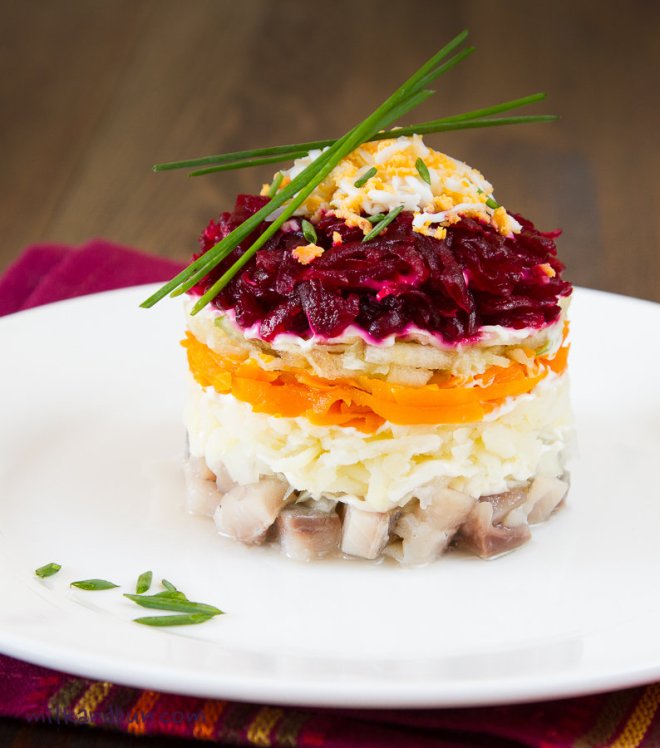
Shuba Salad
 A legend says that such salad was created by a merchant Anastas Bogomilov, who was an owner of the popular tavern and restaurant chain in Moscow at the beginning of the 20th century. It was a time of The Civil War and Revolution in Russia, and taverns’ visitors discussed the Russian future with patriotic fervour, so they became furious and began to fight. And of course, they broke some furniture and smashed plates during their drunken brawls. To avoid it, a merchant devised a stratagem – to make a well-nourishing zakuska (a starter) and a symbol of the public union in one dish. Thus, one of his cooks – Aristarkh Prokopcev prepared and served a new salad ‘shuba’ at the New 1918 Year eve, where red color of beetroots symbolized the red flag, and potatoes were the food of workers and peasants. Shuba was an abbreviation, first letters of a slogan; Sh for Chauvinism, U for Decay, B for Boycott, A for Anathema. Visitors and guests liked this salad and began to order it often. As the salad were fatty, guests couldn’t got drunk very fast, thus scuffles happened rarely and furniture was left untouched.
 Long after, people forgot the origins of the salad, but it became an integral part of the festive new year table.
Russian layered salad - Shuba
Here is my version of the ‘herring under a fur coat’. For the dressing, I usually use only sour cream (it’s healthier), but you can substitute it with mayonnaise, or make it 50/50. Also I add an grated apple – the salad gets freshness, but for someone an apple is unnecessary here. The choice is up to you.

Herring under a fur coat or Russian Shuba Salad

  • Servings: 5-6
  • Difficulty: easy
  • Print
Ingredients
200-300g herring fillet, lightly salted
1 brown onion, finely chopped
2 large potatoes, skin on and boiled
2 large beetroot, skin on, boiled or roasted
1 medium carrot, skin on and boiled
1-2 hard-boiled eggs, chopped or grated, optional
1 juicy and sour apple (granny smith is great), coarsely grated, optional
Dressing
100-150ml (15-20% fat) sour cream, or as much as you like
2-3 Tbsp mayonnaise, optional
1 tsp dijon mustard, optional
salt, pepper to taste
Garnish
dill, parsley or chives, optional
Preparation method
  1. For the dressing, mix all ingredients and season to taste, or use only sour cream. You can spread the dressing with a tablespoon, or use a piping bag.
  2. Cover chopped onion with hot water and soak for 5-10 minutes, it helps to remove the bitterness. Then drain water.
  3. Drain any liquid from herring. Cut herring fillet into small cubes. Make the first layer – arrange herring on a serving plate. Spread onion on herring.
  4. Peel vegetables and coarsely grate or finely chop.
  5. Arrange a layer of potatoes. Cover with dressing. Also you can make potatoes the very first layer, if desired.
  6. Spread eggs, if using, and lightly cover with dressing. Also you can top finished salad with eggs.
  7. Arrange a layer of carrot. Cover with dressing.
  8. Arrange a layer of apple. Lightly cover with dressing.
  9. Finish with a layer of beet. You can only top with grated beetroot, or complitely cover the salad. Spread evenly some dressing.
  10. Garnish with chopped dill or chives, if desired.

The salad becomes much better if you refrigerate it overnight (cover the salad with a foil) or for a few hours.

Enjoy!
Herring under a fur coat
I’m linking this wonderful, tasty and festive salad to Fiesta Friday.

Pokhlyobka – The Old Russian Pottage

 Pokhlyobka is a kind of thick Russian soup made by adding flour, grains, potatoes or other vegetables. It is similar to the Britain Pottage.
 Long time ago, it was a main meal among poor strata of Russian society. Most of the time, villagers and peasant farmers cooked and ate vegetarian pottage, because such expensive ingredients like meat or fish were not affordable for them. It’s worth mentioning that meat was eaten once or twice a year; more luckily were farmers, who had lived near rivers and could caught a fish throughout the year. The dish was easy to prepare, and people could use the remains of the yesterday meal – chunks of boiled potatoes or cabbage, then add extra millet or buckwheat. The rich part also ate pokhlyobka, but it was significantly better and besides potatoes, contained the meat of duck, hazel-hens, and etc.
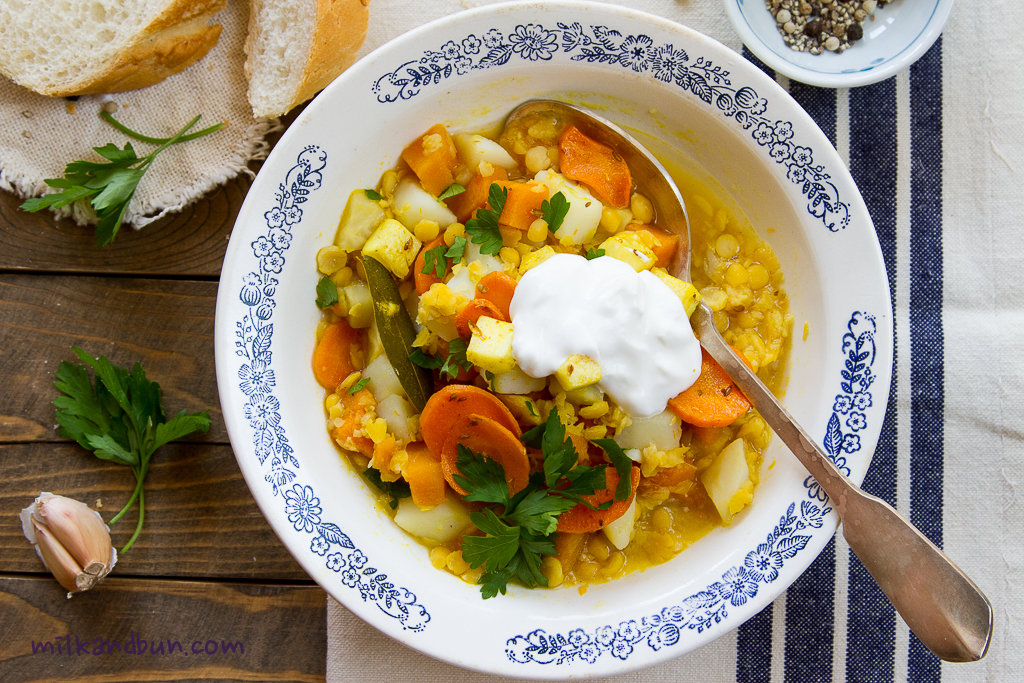
Pokhlyobka
 My recipe of Russian pottage is also without meat.. Definitely, a good piece of fatty pork or beef could makes the pokhlyobka especially rich, so if you’re not a vegetarian you may add it. But I suggest you to try the non-meat option, which is infused with aromatic spices, and delicious pumpkin and thick sour cream make the soup absolutely irresistible!
‘Acoulina cooked absolutely delicious koulebyaks, various pokhlyobki..kvas..soaked apples..’ from the Russian novel ‘Whites, blacks and grays’  by Ivan Lazhechnikov written in 1856.
Pokhlyobka - the old Russian thick soup
  ‘The dinner was absolutely delicious that day: pokhlyobka made from goose meat with wild onions, venison shashlik and slices of bear meat..’ from the Russian novel ‘Plutonia’ by Vladimir Obruchev written in 1915.

Pokhlyobka - The Old Russian Pottage

  • Servings: 2-3
  • Difficulty: easy
  • Print
Ingredients
120-130g yellow split peas
3 small potatoes
300g pumpkin or squash
1 medium carrot, sliced
60-70g celery root, cut into small cubes
1 small onion, thinly sliced or finely chopped
1 garlic clove, chopped, optional
1/2 tsp ground turmeric
1 tsp cumin
2 bay leaves
1.2 l water
1 Tbsp sunflower oil
salt, black pepper to taste
fresh parsley, chopped, for serving
sour cream, for serving, optional
fresh country-style bread, for serving, optional

Preparation

  1. Wash peas, put in a pan, cover with water and soak overnight. Pour out the water. Cover peas with new cold water. Boil on a medium heat for 15-20 minutes, until peas are tender. Skim the foam during the boiling.
  2. Meanwhile, in a frying pan, heat the oil, add spices and fry them for a minute. Add garlic, onion, carrot, celery root and saute vegetables on a medium heat for 8-10 minutes.
  3. Peel and cut into small cubes potatoes and pumpkin.
  4. Add potatoes to the pottage. Season with salt and pepper. Simmer for 8-10 minutes.
  5. Add pumpkin along with fried vegetables, simmer the pottage for 10 minutes more or until the pumpkin is soft.
  6. Adjust seasoning. If the pottage is too thick, add more hot water and stir through.
  7. Garnish each plate with a dollop of sour cream and chopped parsley. Serve with a slice of bread.
Enjoy the old Russian farmer meal! 🙂
I’m bringing this traditional recipe to all lovely people who’s enjoying the FF party today!