Festive Cooking

Fish with spiced lentil ragout

 Happy Valentines Day!!! 
I’d like to represent a very delicious main course, that looks elegant and suits perfectly to this special day. A healthy and tasty fish is complemented here by aromatic lentil ragout and fresh fennel shavings. Another secret weapon in this sensational dish is aromatic spices: turmeric and ginger, that really burst the lentils with lots of flavour. And of course don’t forget the final touch – a drizzle of lime juice.
 Simple! Healthy! Sensational!Fish with spiced lentil ragout

Fish with spiced lentil ragout

  • Servings: 2
  • Difficulty: easy
  • Print
Ingredients
Fish
2 x 150-200g white fish fillet (I used sea bass)
2 tbsp lime juice
freshly ground sea salt and black pepper
some homemade breadcrumbs and flour, for coating
1 tbsp olive oil or other veg oil, for frying
Lentil ragout
100g dried green/brown or Puy lentils
1 rosemary sprig
water
1.5 tbsp olive oil
1 small red onion, chopped
1 small carrot, cut into fine cubes
1 garlic clove, finely chopped
1 tsp fresh grated ginger
1/2 tsp turmeric powder
1 medium tomato, chopped (without liquid and seeds)
1.5 tbsp tomato puree
zest from 1/2 lime
freshly ground sea salt and black pepper
Garnish
lime juice
lime wedges
fennel shavings
fennel or parsley
Preparation method
  1. Rinse and drain lentils. Put in a saucepan with rosemary, cover with water (do not season) and bring to boil on a medium-high heat. Reduce the heat to low and simmer uncovered for 20 minutes or until lentils are tender. Add extra water if all absorbed, or drain some if there is any left.
  2. Meanwhile, heat oil in a small frying pan, add onion and carrot and saute for 6-7 minutes until soft and golden. Add garlic, ginger, turmeric and saute for a minute more. Stir in chopped tomato and puree. Turn off the heat.
  3. Discard rosemary form lentils. While lentils are still warm season with salt and pepper, then mix in lemon zest and vegetable mixture; give it a good stir.
  4. Drizzle fish with lime juice, season with salt and pepper. Sprinkle skin side with breadcrumbs and flour. Heat oil in a frying pan and fry skin-side down for 2 minutes, then turn and fry for 1-3 minutes more (depends on fish thickness), until golden and cooked.
  5. Arrange lentil ragout on a serving plate, top with fennel and fish fillet, drizzle with lime juice. Garnish with fennel (or parsley) and lime wedges.
Enjoy!

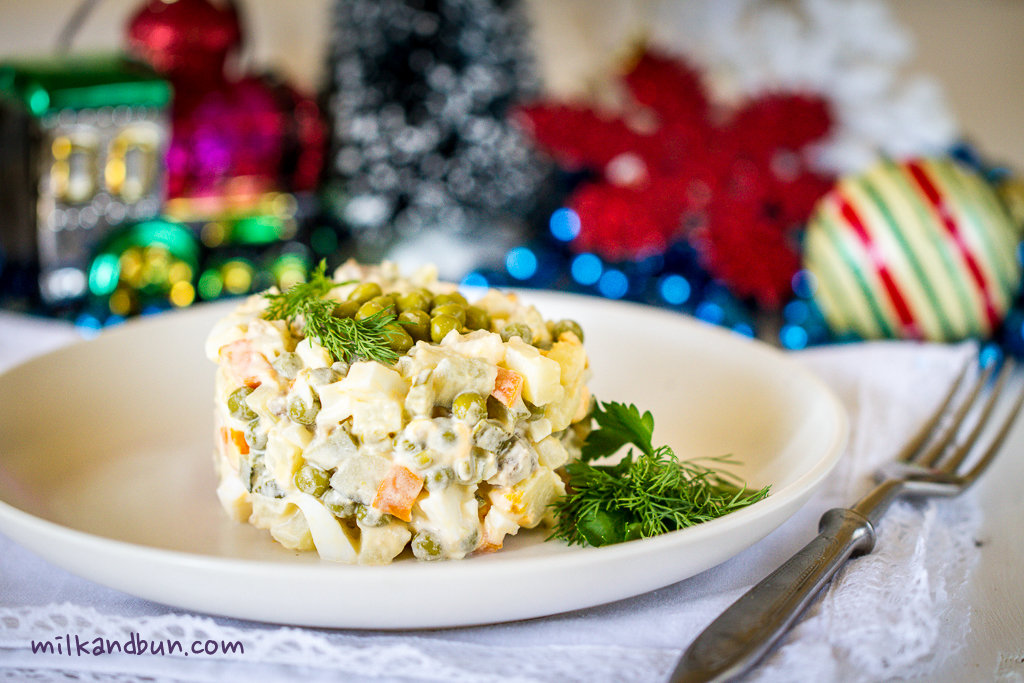
Russian Winter Salad (Olivier salad)

 This salad is a traditional dish in Russian cuisine, and most of the time it is associated with New Year celebration, when it’s always served on a festive table along with another popular salad – “shuba”.

 The very first and original version of this salad was invented in the beginning of 1860s by chef Lucien Olivier, who was the owner of the renowned Moscow restaurant “Hermitage”. “Olivier Salad” quickly became popular among restaurant visitors, the salad brought him a great fame and became the signature dish. The recipe and especially the dressing was kept in a big secret, and unfortunately the fact is that the exact recipe is still unknown. But according to some notes, it’s known that the salad contained hazel grouse, veal tongue, black caviar, fresh salad leaves, crayfishes or lobster, some pickled, fresh cucumbers, capers and boiled eggs. And the secret dressing was prepared from fresh raw eggs, some secret herbs and olive oil. 
 As you can see, all ingredients were posh and expensive. So, lately during Soviet time, these fine ingredients were replaced by cheap and widely-available, like boiled kolbasa (bologna sausage) or meat, boiled potatoes and carrots, pickled cucumbers and peas, dressed with store-bought mayonnaise instead of home-made French dressing. Such simple and nourishing salad was widely-popular, and soon it became a staple and traditional dish of Soviet holiday dinner, and particularly of New Year’s Eve. Lately, it’s even got a second name – “Winter Salad”. Beyond Russia this salad is often called as “Russian Salad”.Russian Winter salad
 Nowadays, the salad is still a traditional part of New Year celebration, but there are lots of versions – with boiled beef or chicken, beef tongue, fish and caviar, fresh or pickled cucumbers and so on. My recipe is a common version of the Winter Salad – with boiled beef, pickled cucumbers and mayonnaise. It’s a little bit on a dark/unhealthy side of my diet 😀 but consuming it on the holiday dinner is also a part of Russian tradition, so eating it once a year don’t make anyone fat. 🙂 Enjoy!
Olivier or Russuian Winter salad

Russian winter salad (Olivier salad)

  • Servings: approx 8
  • Difficulty: easy
  • Print
You can garnish the salad with some peas and chopped dill or parsley.
*Add more cucumbers if using small gherkins.
Ingredients
350g beef (one whole piece, without any bones)
300g/ 2 large potatoes
1 large or 2 medium carrot
4 medium eggs
4 medium pickled cucumbers*
1/2 medium brown onion
1 can of green pea
mayonnaise, to taste
salt, to taste, optional
Method
  1. In a pan, put meat and cover with cold water, bring to boil, reduce the heat to medium, cover and simmer for about 50 minutes or until meat is ready. Completely cool and cut the meat into small cubes (about 1 cm).
  2. In another large pan, put potatoes and carrot in their skin, cover with water, bring to boil, reduce the heat to medium, cover and simmer until veggies are soft. Cool, peel and cut into small cubes (about 1 cm).
  3. In another pan, hard-boil eggs. Also cut into cubes.
  4. Finely chop the onion, put in a bowl, drizzle with some apple vinegar and cover with hot water. Leave for 15 minutes, then drain.
  5. Also cut the cucumbers into small cubes.
  6. In a large serving bowl, add all ingredients along with drained peas. Dress with mayo to suit your own taste.
You can keep the undressed salad in the fridge up to 2-3 days.
Enjoy Russian Winter Salad!

Holiday Panna Cotta

   Cold days, beautiful pine and spruce trees with toys, lots of gingerbread cookies, smell of mandarins and cinnamon.. How does your holiday look and smell?Holiday Panna Cotta

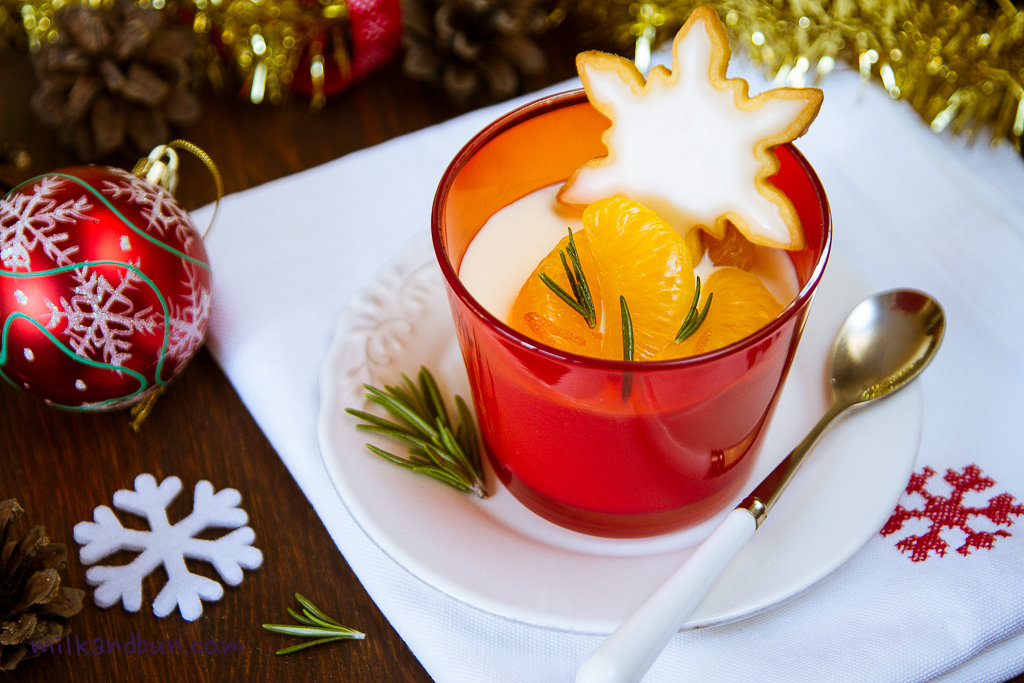
 Today recipe is a well-known dessert among foodies – panna cotta. Many of you already cooked it or tried in a restaurant, but I’d like to show you the festive presentation, how you can serve the gorgeous-looking dessert to your family and guests during the winter holidays.
 Everything in this dessert says ‘winter’: delicate and tender snowflakes (recipe coming soon), smooth and creamy panna cotta that looks almost like a real snow-blanket, rosemary “pine needles”, and of course aromatic mandarin -segments. Another great thing about this dessert is that it looks like you really fussed over it. Shhhh…  😉
Panna cotta with cookie and mandarin
 You can make panna cotta a day or two ahead, and you will need only to saute mandarin segments and garnish the dessert. But don’t forget to cool mandarins, otherwise panna cotta will melt.

Holiday Panna Cotta

  • Servings: 4
  • Difficulty: easy
  • Print
Ingredients
Panna Cotta
200ml double cream
300ml full-fat milk
45-50g white sugar
1 vanilla bean (or 1 tsp vanilla extract)
2 tsp powdered gelatin
40ml cold water
Garnish
1-2 tbsp demerara or brown sugar
2 small mandarins
few rosemary needles
2 tsp mandarin zest, optional
1 tbsp orange liquor (or brandy), optional
1 mandarin shortbread cookie per cup (recipe is coming)
Preparation method
  • In a pan, pour cream with milk, add vanilla and sugar, heat (but don’t boil) until sugar is dissolved. Turn off the heat and let the mixture infuse with vanilla flavour for 20-30 minutes. Then take out the bean, and rewarm the mixture.
  • In a small cup, add cold water and sprinkle gelatin over it.
  • Take the pan from the heat, add gelatin and stir until the gelatin is completely dissolved.
  • Pour the panna cotta mixture into 4 cups, put cups in the fridge for 4 hours or overnight.
  • For the garnish, in a frying pan add sugar, mandarin segments, zest and rosemary, and saute for 3-5 minutes on a medium-high heat. Add liquor, if using, and saute for few minutes more. Leave to cool.
  • Garnish each cup with few mandarin segments and one cookie.
Happy Holidays!
Panna cotta with mandarin and rosemary

Baked apples with walnuts and cowberries

Hi there! It’s been windy, dark and gloomy all day here in Dubai today. The weather intends to spend a day in the kitchen and bake something warm, aromatic and tasty. And I found a deliciously satisfying dish to cheer this day up! Sweet-smelling baked apples with super tasty filling: walnuts and cowberries! Sounds fantastic, doesn’t it? The cozy smell of cinnamon and brown sugar was filling my kitchen while apples were baked.. It’s so easy to turn regular apples into a fabulous warm dessert! Enjoy!

Baked apples-1Baked apples-2

 Cowberry (also known as lingonberry) is a very tasty, slightly bitter and sour berry; it contains lots of vitamin C, A and B. It’s a popular type of berry in my home-country (Russia), and as far as I know in Sweden and Norway. Their taste remind small sour cranberries, so you can easily substitute it with cranberries (fresh or frozen).Baked apples with walnuts and cowberry

Baked apples with walnuts and cowberries

  • Servings: 2
  • Difficulty: moderate
  • Print

*You can add more sugar to suit your taste.
**I dry-roast walnuts, then chop it or pulse in a food processor.
Ingredients
2 large apples (sort ‘pink lady’ or ‘granny smith’ are good)
20g/2 tsp butter
3 tsp brown sugar*
1/2 tsp cinnamon
1 quail egg, optional
5-6 tsp finely chopped walnuts**
3-4 tsp cowberries (if using frozen-no need to defreeze)
1/2 tsp of cinnamon, for garnish
2-3 tsp pure runny honey, for serving
some extra walnuts and cowberries, for serving
  • Cut the lid from apples, carefully cut out the core and make a hole in each apple leaving the bottom.
  • In a bowl, stir sugar and cinnamon with butter. Mix in the egg. Fold in chopped walnuts and berries.
  • Put apples in baking dish/tray and stuff each apple with filling mixture. Cover with apple lids. Pour some warm water into the bottom of the baking dish (1 cm). Loosely cover with foil.
  • Bake in preheated 200C oven for 30 minutes. Uncover and bake for 10-15 minutes more, or until apples are tender but not mushy.
  • Carefully transfer to a serving plate, sprinkle with cinnamon, drizzle with honey and garnish with some walnuts and cowberries, if desired.
  • Enjoy!

Russian Easter. Kulich

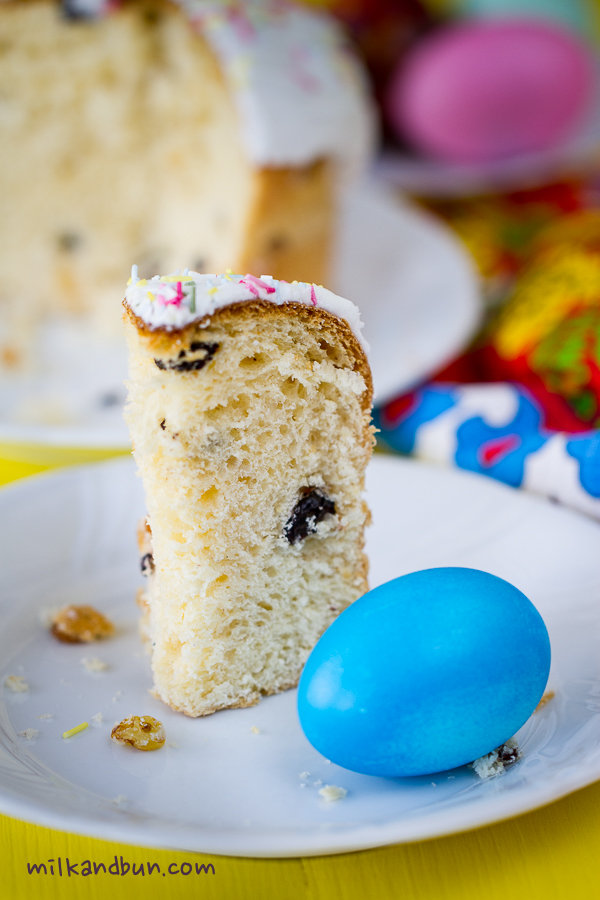
 Today is Paskha (Easter) in Russia, it’s a bright and warm festival that is celebrated among Orthodox Christians. Traditional and famous treats for this day are the colored eggs, kulichi, and paskha (in my next post). During this day we congratulate each other and say ‘Христос Воскресе’ which means Christ is risen, and the reply is ‘Воистину Воскресе’ – indeed hi is risen.Easter cake-Kulich
 Kulich is a special Easter sweet cake/bread which usually has a cylindrical shape and decorated with white icing. It’s made from rich yeast dough; raisins, currants or candied fruits can be added. Traditionally kulichi have a cylindrical shape, and some Russian housewives use empty tins from pea or beans for that purpose. After baking and cooling kulichi is glazed with white icing (egg white or water with sugar) and decorated with edible sugar beads, flowers, and thin candles. Kulichi and died eggs can be also blessed in church; a part of Easter treats usually is leaved in church for poor people.Kulich- Russian Easter cake

Kulich recipe {Russian Easter cake}

  • Servings: 2 pieces
  • Difficulty: moderate
  • Print
I used large eggs. Egg for the glazing needs to be very fresh.
The dough should be soft, but if needed add more flour.
 

Ingredients

350g plain flour

5-6g yeast
small pinch of salt
130ml milk, warm
1 egg
1 egg yolk
80g white sugar (or 90-100g to make it sweeter)
1 tsp vanilla extract or vanilla sugar
50g butter, very soft but not melted
60g raisins (golden)
60g currants (dark)
Icing
1 egg white
150-160g icing sugar
1 tsp lemon juice
Sprinkles for decorating
Preparation method
  1. In a large mixing bowl, sift 100g of flour, add salt, yeast, warm milk and stir to combine. Cover with a wet kitchen towel and let it rise for 30 minutes.
  2. Meanwhile, in a small bowl, whisk a whole egg, egg yolk, vanilla and sugar with a hand or electric mixer for 2-3 minutes until pale. Add egg mixture and butter to the dough, mix to combine. Sift the remaining flour and knead to combine. Cover again with a wet kitchen towel and let it rise for 30-40 minutes.
  3. Wash raisins and currants, blot it up with a paper towel, sprinkle with a teaspoon of flour – you need to cover all raisins with some flour, it allows them to be evenly distributed throughout the dough. Add raisins and currants to the dough, mix into the dough. Cover with a wet kitchen towel and let it rise for 60 minutes.
  4. Line baking pans with baking paper, grease with butter. Divide the dough between two baking pans, the dough should occupy 1/3-1/2 of the volume (because it will rise very high during baking) of the volume. Cover and let it rise for 20-30 minutes.
  5. Bake in preheated 100C oven for 10 minutes, then in 180C for 30 minutes or until the toothpick inserted into it gets back dry. If the top becomes too golden – cover kulichi with a piece of foil or baking pepper.
  6. Take out of the oven, let it completely cool.
  7. For the icing, whisk the egg white with few tablespoons of sugar and lemon juice until well combined. Or beat it with an electric mixer on a low speed. Gradually add more sugar and whisk again. Keep adding sugar until you get the desired consistency (not too liquid).
  8. Spread the icing on top of each kulich with a tablespoon. Add sprinkles. Let it dry.

Enjoy!

Cover kulichi in the foil and keep in the fridge for up to 3-4 days.

Russian Easter sweet cake -kulich